

This is a companion piece to DeBonked: Bunk Tales of Online Reverie (“Part One”), which first examined the extraordinary claims of FinTwit’s @bonkdacarnivore. A brief recap follows, but readers seeking the full backstory should start there.
The Bunktionary
Before we dive in, let’s start by having some fun with a definition of terms.
Bunk: The star of this twisted little fantasy, X user @bonkdacarnivore, is often referred to by others as Bonk. But I call him Bunk because damn near everything he says is…well…bunk.
Bunk Lore: The accumulated body of autobiographical claims, anecdotes, credentials, relationships, and feats attributed to Bunk. Known for its unusually elastic relationship with independently verifiable reality.
Bunktard: Any sentient being capable of independent, rational thought who not only continues to believe the stories Bunk tells himself but also slavishly defends him at every turn.
BVC: The Bunk Victim Collective - a group of individuals who claim to have experienced some form of online harassment from Bunk.
BCU: The Bunk Cinematic Universe - a sprawling, interconnected narrative world in which the events, characters, credentials, institutions, lawsuits, sporting achievements, military exploits, fortunes, and other elements of Bunk Lore coexist. Continuity errors are common.
Bunkflation: The tendency of Bunk Lore to become progressively more impressive with each retelling. Ordinary competence → elite expertise → world-class achievement → somehow you are now talking to one of the most accomplished humans alive.
Bunkruptcy: The terminal condition reached when accumulated factual liabilities exceed the remaining assets of plausible deniability.
LARP: Stands for live-action role-playing, which is a game where participants physically act out characters in a fictional setting using costumes and props. It’s also become a popular internet slang term used to describe someone who is pretending to be something they are not, or faking an identity or lifestyle.
FinTwit: Shorthand for Financial Twitter, an online community of finance and investing enthusiasts who use X (fka Twitter) to share news, ideas, charts, etc.
Furu: Shorthand for financial guru.
Previously, on DeBonked
In Part One of DeBonked, we met FinTwit’s answer to the Most Interesting Man in the World, an anonymous X account whose résumé reads like someone forgot to stop prompting ChatGPT.
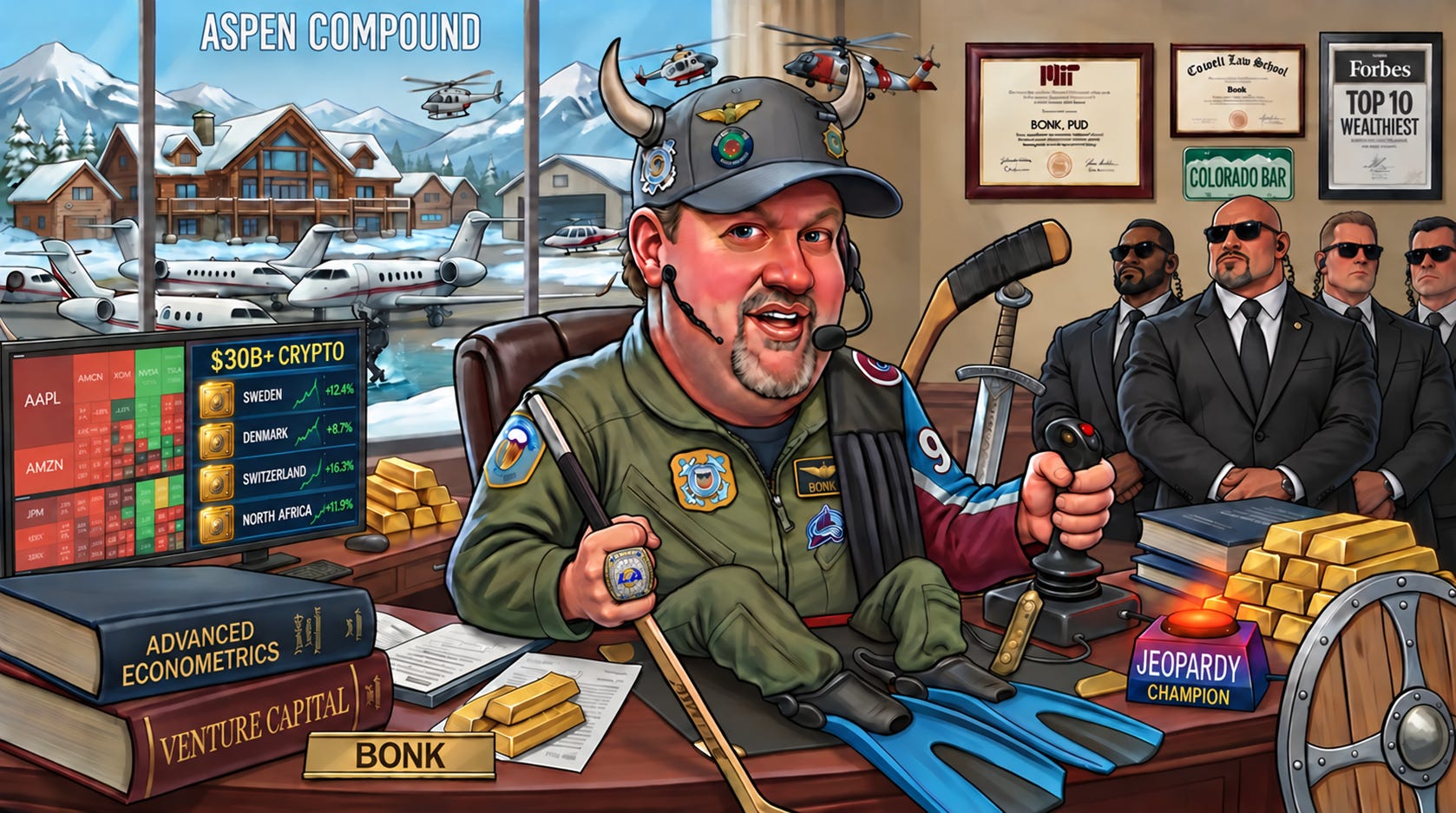
Eight degrees. Jeopardy champion. Coast Guard rescue pilot. Founder of a $30 billion venture capital firm. Tech executive, near-professional hockey player, and allegedly world-beating trader with a $26 billion day-trading account. All while amassing a fortune approaching twelve figures.
We call this sprawling mythology Bunk Lore, and subjected a portion of it to some basic dude diligence in Part One. His own posts supplied the bulk of the material: shifting claims, conflicting timelines, implausible economics, and commentary that repeatedly betrayed unfamiliarity with the world he claimed to dominate.
The resulting portrait was of a persona whose supposed wealth and accomplishments served as substitutes for evidence in pursuit of credibility building, and whose audience seemed remarkably willing to accept the exchange.
Part Two picks up where that examination left off, but let’s recap that Bunk Lore for the newbies here:
Academic superhuman: First degree as a teenager before going on to earn eight of them, including MIT credentials in computer science, biochemistry, physics, and economics, a PhD, an MBA, and a Cornell JD. Smarter than Einstein, with near-perfect historical recall.
Rescue pilot and family patriarch: Former Coast Guard search-and-rescue pilot who met his vascular surgeon wife after rescuing one of her relatives. Father of four exceptionally gifted children, including students at Caltech and Duke - the latter having rejected Harvard, natch - with Mandarin proficiency also featured.
Distinguished ancestry: A rocket scientist father, a long line of warfighters, Viking heritage, and descended from an American forefather. Cities supposedly named after him.
Venture capital titan: Founded a firm now managing more than $30 billion, created tens of thousands of jobs, and retained an uncommonly lucrative ownership interest after leaving. Claimed carried interest tax savings whose implied economics Part One interrogates.
Corporate heavyweight: Left venture capital to spend more time with family by becoming a major technology company’s CISO…as one does. Elon Musk supposedly wanted to discuss his becoming X’s CISO, which is probably news to Elon Musk.
Almost unimaginably wealthy: Something on the order of $100+ billion in personal wealth, with only around 30 people richer in the world. Early bitcoin investments and crypto holdings exceed Strategy’s ($MSTR).
Property magnate: Initially more than 30 properties, subsequently more than 100 across all 50 states. Residences in Southern California, Colorado, Montana, and Tampa, including a 25-acre Aspen estate.
Private aviation enthusiast: Three planes, subsequently four, including an evolving Falcon 7X story. A Tampa compound with a helipad and private landing strip.
Renaissance tough guy: Almost went pro in hockey; certified divemaster; bladesmith with a weapons room; elaborate board-game rooms; 22 bodyguards. Depending on the day, standing at 6’1”, 6’2”, 6′3″, or 6′4″, built like a Viking, with unusually high testosterone and assorted anatomical boasts.
Trading demigod: A $26 billion trading account, a 98% annual hit rate, near-undefeated subsequent performance, and claims to be the world’s best trader. Marty Zweig as his mentor, plus a family NYSE seat supposedly allowing him to trade on the floor.
Financial prodigy from infancy: Perfect credit attributed to his parents obtaining a credit card for him at age three.
Serial retiree and compound impresario: Retirement at 29 and again in his mid-40s; annual Memorial Day fireworks at his Aspen compound, which the piece checks against information from the local fire chief.
Importantly, Part One ended with a cheeky description of a person I believed Bunk to be. As someone who enjoys solving puzzles, especially when it comes to unmasking nefarious actors online, I was rather proud of my sleuthing and convinced I had his true identity nailed.
That original post generated a fair amount of interest, and I quickly began fielding messages from the BVC informing me that I had the wrong guy.
Unbeknownst to me at the time, I was snooping in the footsteps of others who had collectively arrived at a theory that Bunk was actually a gentleman from Aurora, Colorado named Chance Daniels.
It turns out Bunk had ruffled plenty of feathers by the time I found him, and those birds had flocked together to put in their own detective work on this strange character. And they convinced me pretty quickly that I had the wrong guy indeed.
What we often see in cases of assumed identity is the perpetrator taking pieces from the lives of others around them when building their fictional persona. In this particular instance, Bunk posted a photo of a house that he claimed to be his own. And in his infinite wisdom, he blocked out the background so no one could geolocate his position (which he bragged about doing because he’s always a step ahead).
Well, the structure itself remained in frame, allowing for a quick image search that took us to Zillow for the details of a home outside of Seattle. (We’re not reposting that picture here to protect the privacy of the innocent).
An ownership check showed the owner to be a technology writer and, importantly, board game fanatic, something we knew Bunk to be given his repeated posts on the topic. Some deeper digging - including failed attempts at voice analysis - had me fully convinced we had our guy.
But it turns out I was wrong - at least as far as I had been convinced - and Bunk appeared to be borrowing the home of what looks to be a gaming friend to pass off as his own.
The evidence provided was revealing. The most convincing bits came in several forms, including a unique Queen album that Bunk bragged about (in posts since deleted), the very same of which turned up in an Ebay listing under the same username we’ve attached to Chance across other social media accounts (“nerdfumaster”).
But the most devastating piece of evidence was a political contribution Bunk bragged about whose public records pointed to a P.O. Box in Aurora, CO.

That address was indeed connected to one Chance Daniels through various avenues, a point I will not belabor here out of privacy considerations for his partner. But suffice to say my mind was quickly changed as to what was likely to be Bunk’s true identity.
More on that later.
In addition to outreach from the BVC, I also received some limited feedback from a few brave Bunktards.
Most told me I wasted my time and should get a life.

Some appeared to be true believers.

Others suggested obfuscation is just the name of the game in cybersecurity circles.
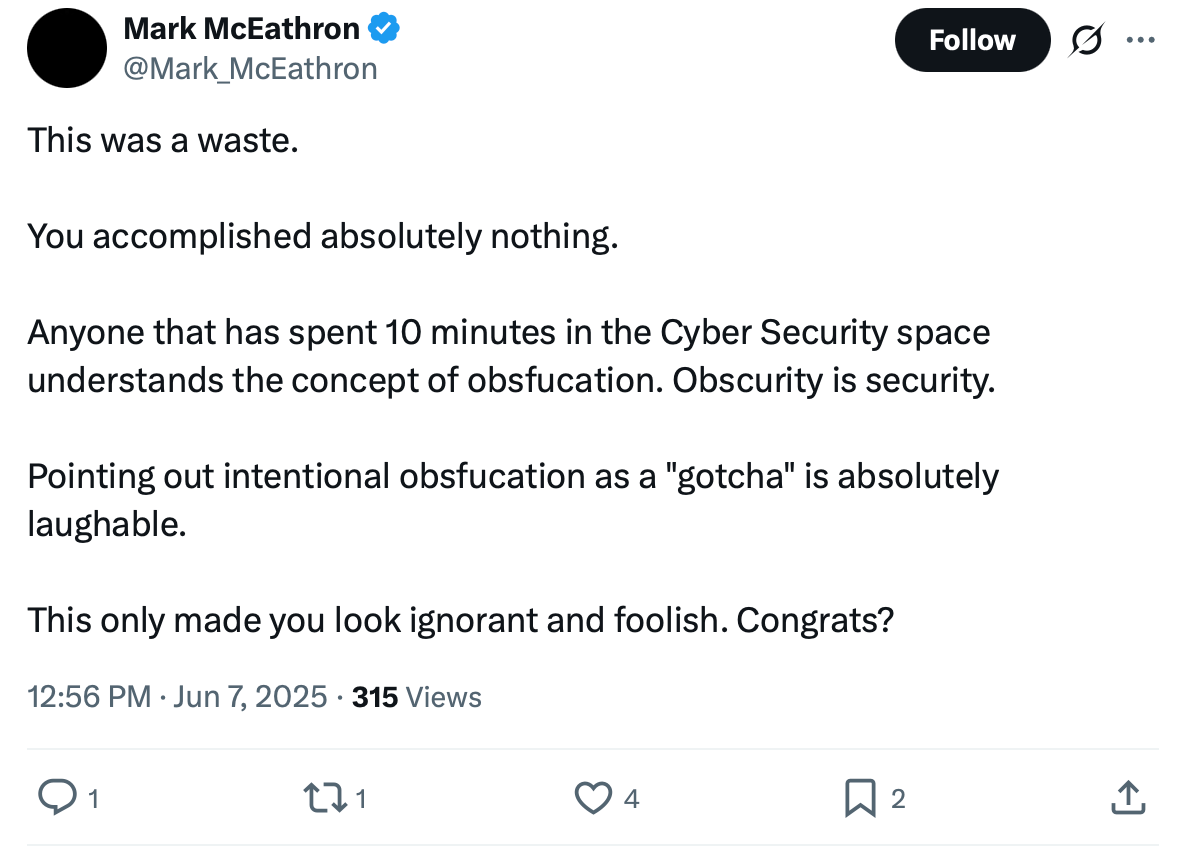
And this guy gave me much more to think about.

Notice how none of these replies directly address a single claim in the piece beyond just vibes. Some dismissed the investigation, some trusted the performance, and some explained away inconsistencies because obfuscation is the name of the game in cybersecurity.
London’s reply is especially revealing as it seeks to recast the act of investigating Bunk as evidence my feelings were hurt and that I’m spending an unhealthy amount of time thinking about him. “Get some sun” does the work that an actual rebuttal would otherwise have to do.
I never thought I’d be getting life advice from a pornstar, but here we are.
London’s reply shows how easily scrutiny gets waved away as obsession, a tactic often used to stifle free inquiry. It’s the same reflex behind dismissing every criticism of Donald Trump as “Trump Derangement Syndrome.” The label supplies a convenient substitute for an argument. If the critic is unceremoniously deemed irrational or obsessed, there’s no need to grapple with the substance of the criticism.
It’s an attempt to make scrutiny itself seem suspect and to discourage anyone else from asking the same questions.
Such was the reception. But the more interesting response came from Bunk himself, whose efforts to explain away the scrutiny would supply plenty of material for a sequel. In the months that followed, Bunkflation spiked to record levels, and keeping track of it all became an increasingly entertaining exercise.
The Plot Thickens
I was a bit naive in how I approached Part One. For one, I failed to fully appreciate how malignant a character Bunk had created for himself.
I didn’t grasp just how much of an asshole this guy was. I mean, I knew he was a disingenuous blowhard with boorish antics and negative self-awareness. But I was largely unaware of the trail of harassment he had left in his wake.
Stories of alleged doxxing, cyberstalking, and witness intimidation were common. His treatment of women appeared especially abhorrent, with his favorite misogynistic insult being regular reference to a woman’s “holes”.
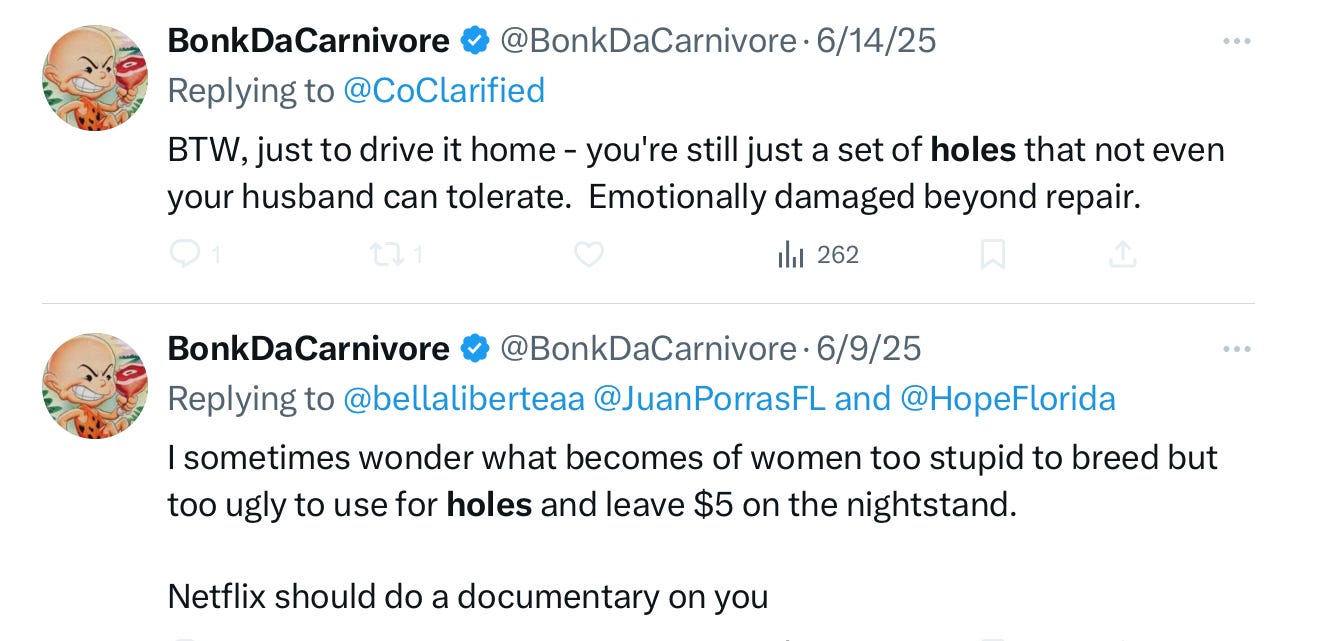

This one feels especially London-coded.

Lovely sentiments from a man who claims to be a girl dad amirite.

Here again, I won’t go into further detail out of respect for individual members of the BVC. Those are their stories to tell, not mine. But my investigation of the record suggests that Bunk has certainly accumulated his fair share of “hit points”, just not of the noble variety.
And while I dragged him plenty, my other mistake was foolishly putting myself in his shoes and wondering how I might respond to such devastating treatment of my make-believe persona.
I figured he’d tuck tail and slowly fade from the scene, overwhelmed by shame given the obviousness of his fuckery being called by someone possessed of the expertise he falsely claims for himself.
Well, he did tuck tail in a way, resorting to the common grifter gimmick of immediately blocking those who dare challenge them.

And since we live in a world where shamelessness has become a virtue, Bunk not only denied the accusations of charlatanism but effectively quadrupled down on his fantastical claims to great power and wealth. Not just by fattening the fictional file on his imaginary persona, but by engaging in increasingly erratic behavior and elevating the threat posture of his online harassment campaigns.
His first related post following publication of Part One intimated that his crack security squad - who we’re told keeps files on everyone Bunk encounters online - provided him with a file on “someone” (obviously me) who’s been banned from the financial industry because of fraud.
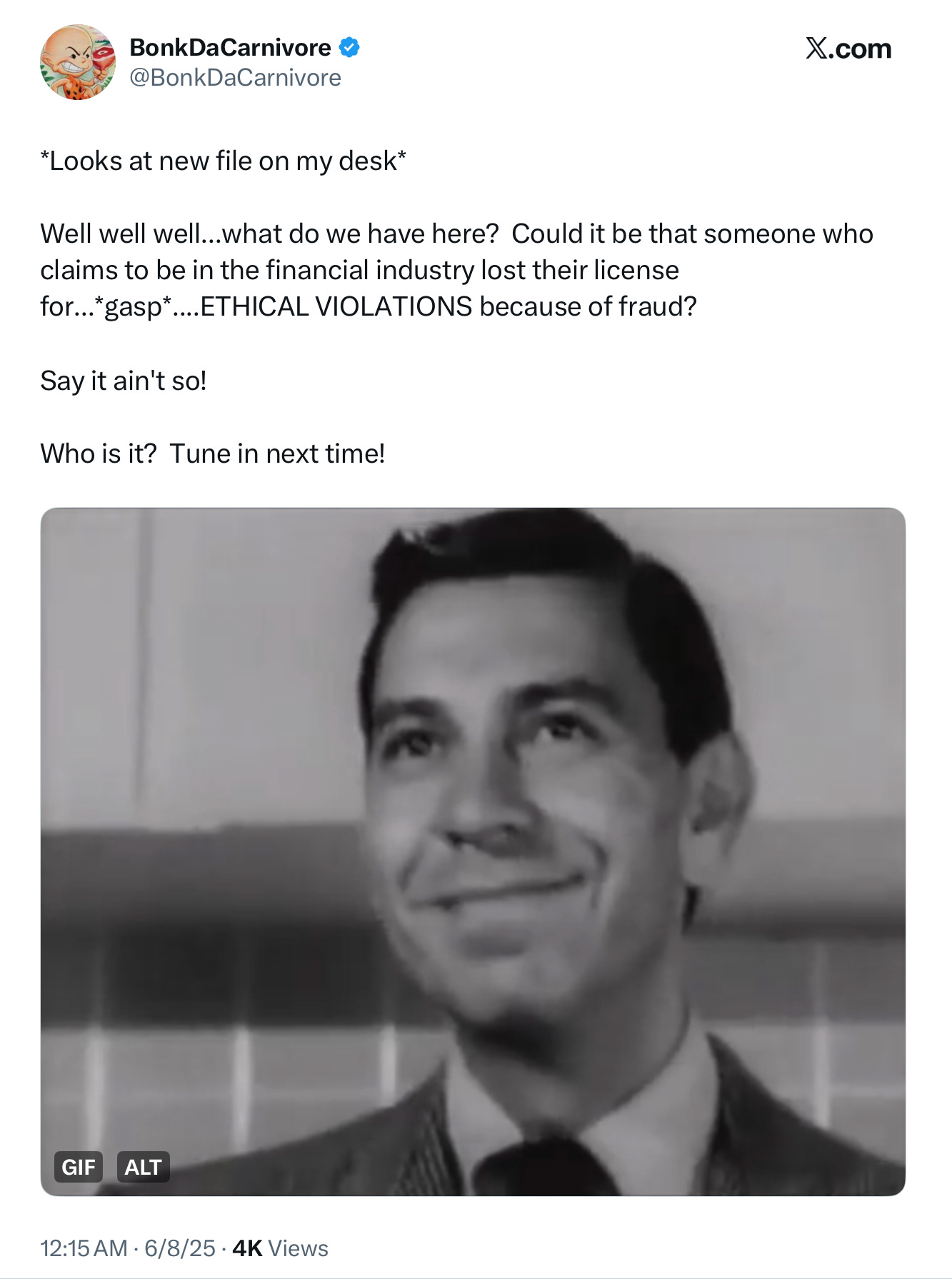
In case you’re wondering if he may have been referring to someone else, he wasn’t:

Up until then, I was strongly convinced that Bunk was a liar. I mean, how could I not be? I nonetheless left room for the possibility that I could be wrong about him. This is a nasty little habit I’ve developed over the years: be cautiously confident and conservatively certain.
But this is when I knew Bunk to be a liar with complete certainty, since I of course have never been accused of or sanctioned for anything much less banned from any industry.
Notice too the theatrics involved. One can picture a movie scene with an intel file being duly delivered to a shadowy Bunk, his silhouette framed by the rising smoke of a Cuban cigar as the scene fades to black to the sound of his maniacal laugh.
He also claimed to have secured a subpoena that compelled Substack to provide him with my personal identification information within a very tight window.

The above message was posted on Sunday, June 8, 2025, two days following the publication of Part One.
So we’re meant to believe that Bunk was able to secure a subpoena, deliver it to Substack - a company known to be protective of its writers - and convince them to expedite access to my personal details over the course of a weekend.
Substack policy notes that reasonable efforts are made to notify users when such legal requests are received. Of course, I was never notified of any such request. Attempts to confirm with Substack whether any such request was made proved fruitless, as all they could do was repeat their policy that attempts are made to notify users in such situations.
Thanks Substack!
The VC line is just silly and will be addressed later. And I’ll either be doxxed or dox myself eventually, at which point Bunk will look even sillier than he already does when my industry bona fides are laid bare for all to see, which includes some CEO titles to boot.
It’s a strange experience to be presented with complete fabrication about oneself and be largely powerless in the face of it. This is how two-way anonymity creates an asymmetry of accountability. Bunk can make grand claims about himself and level spurious accusations against others, while withholding the information that would allow people to properly assess either. Meanwhile, my anonymity limits what I can disclose to rebut him without compromising my own identity in the process.
There’s something Kafkaesque about it. I know the accusation is blatantly false, yet find myself trapped in a reality where that knowledge counts for nothing amongst a certain subset of motivated observers. Such are our online lives today.
Things only got funnier from there.
I held a rare Space shortly after publication of Part One at reader request. Unsurprisingly, Bunk was nowhere to be found. But a couple brave Bunktards showed up to speak, led by an outspoken character on political X who goes by the name Croaky, an appearance lauded by Bunk for getting me to confess to lying about my background.
Croaky’s big gotcha moment was ostensibly catching me in a contradiction, apparently derived from me at once claiming to be a hedge fund guy as well as venture capitalist. When asked for proof of my telling of such twisted tales, Croaky pointed to this section from Part One as evidence:

The fail here is comical. Croaky took the collective “we” above to mean that I was referring to myself as a VC guy, when the very next sentence makes clear I’m referring to “we” as investment firm founders broadly defined.
Bunk and his fellow Bunktards also took a long-running joke on FinTwit to assign me a title for this imaginary VC background I have. You see, given my investigative treatment of certain FinTwit personalities, practices, and products, I’ve been jokingly called the Chief Compliance Officer of FinTwit.
Unlike the insecure among us, I’ve leaned into this joke by happily embracing the title. And when Croaky brought it up on my Space, I laughingly confirmed that I am indeed a Chief Compliance Officer, which everyone on FinTwit understood to be a joke except for our intrepid gator friend.
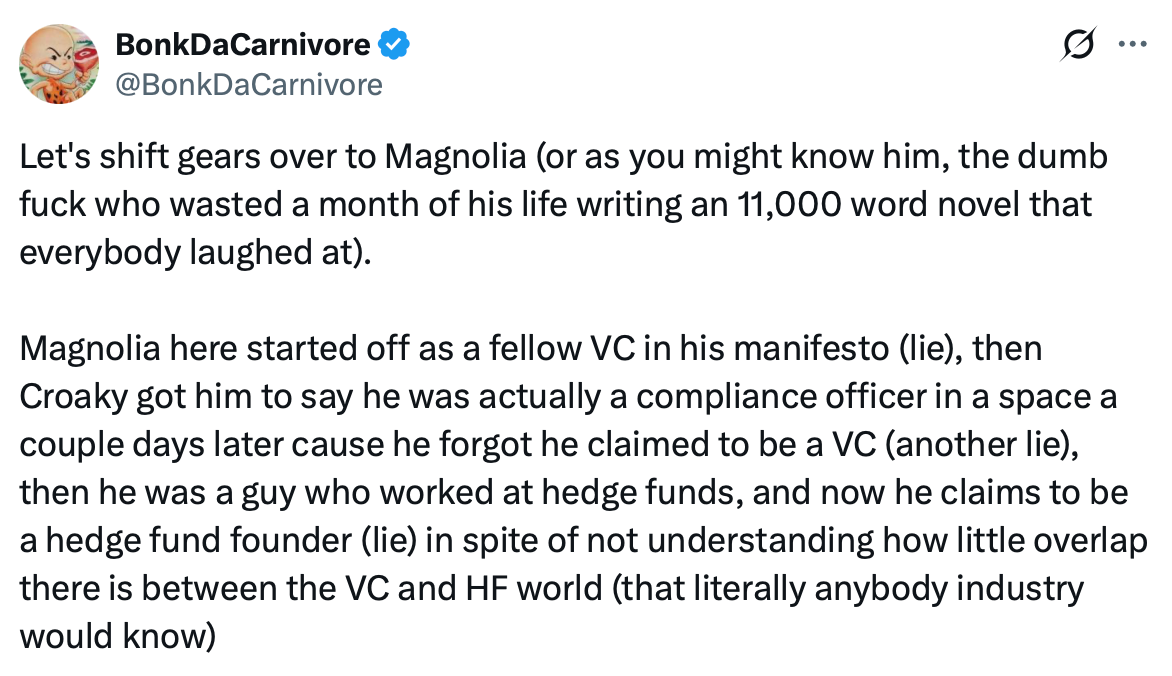
For the record, I’ve never referred to myself as a venture capitalist. That’s because I’m not one. Nor would I ever want to be one. Followers of mine know my opinion of that part of the alternative investment universe - and it’s not a flattering one.
This is just one of many bizarre claims Bunk is prone to make, as he has a strange tendency to level accusations that seem to come from nowhere. Just check the below post. Me spending $100,000 writing a Substack post is just crazy talk - no idea where he came up with that nonsense - and characterizing my home as a “hovel” only further confirms that this man has no idea who I am or where I live.
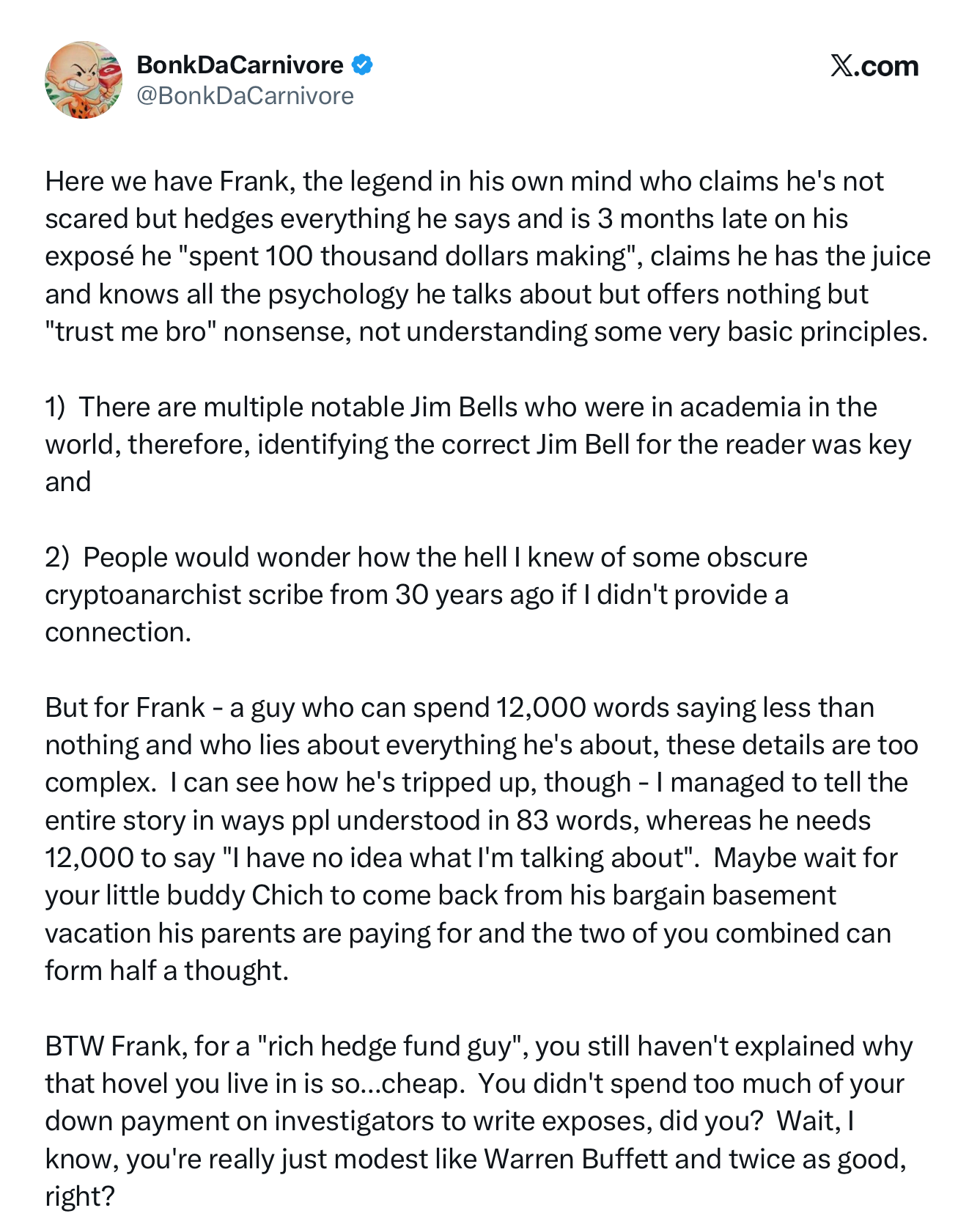
This all begs the question as to why Bunk would be barking up such the wrong tree when he’s got all this impressive access to security and intelligence resources.
There was also a Space where a woman called Queenie - an experienced bitcoiner herself - challenged Bunk about his claim to having amassed the world’s largest bitcoin stack outside of the coin’s pseudonymous creator.
She did so by asking him a simple question about his security architecture that one would expect a whale with a cybersecurity background to understand very well. Instead, Bunk was hilariously clueless on the topic, bumbling his way to an answer about how some other nerds deal with that stuff.
That interaction alone speaks to why Bunk wouldn’t be caught dead in a Space with me. As lethal as Queenie was in that brief confrontation, one can imagine how an even longer conversation with me would go.
Queenie caused Bunk to puke all over his tie with just one line of questioning, which he naturally took in stride as the misogynist he is.

This post is long enough already, so I won’t rehash everything here. But one of my favorite meltdowns occurred a couple months later when Bunk eagerly announced to the world that I and certain others were all going to jail.

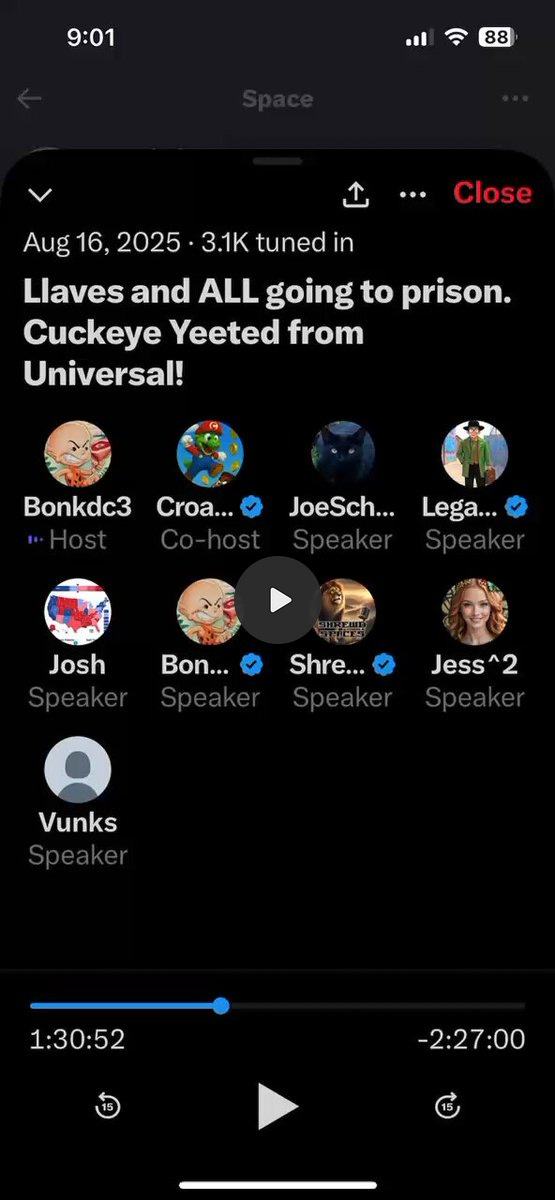
This is a man in zero control of the situation, flailing about like a powerless weasel. Best he could do is make up things about his detractors and level embarrassingly empty threats about jail time for them. For what, nobody knows. But it’s coming!
(Editor’s note: I am aware of no resulting charges against any of the people he threatened.)
I of course had to join in on the fun, which prompted another hilarious attempt at shadowbarking from Bunk.
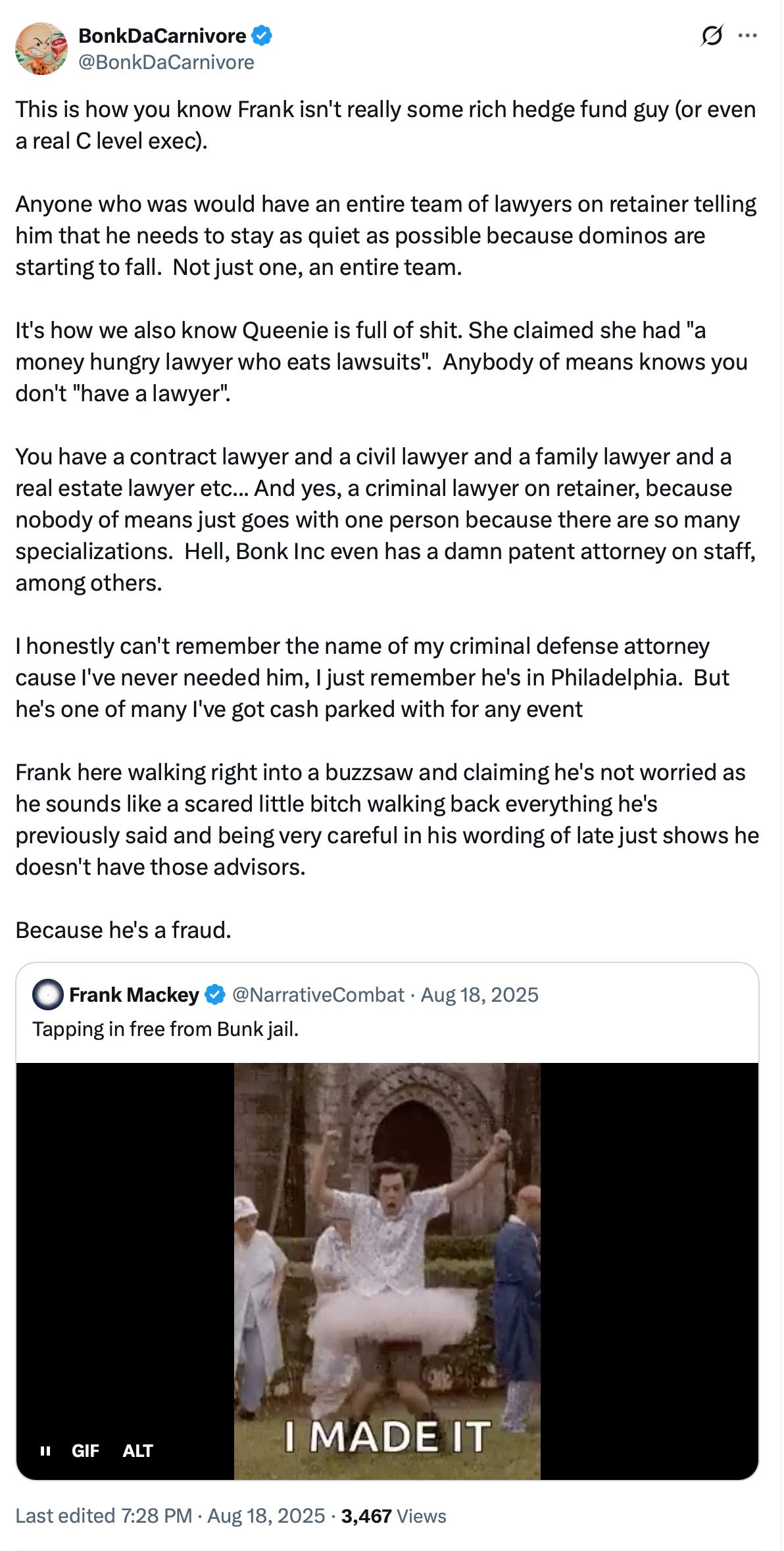
The first thing to laugh at in the above post is the comical explanation of what having a lawyer entails for anyone with “means”. Bunk apparently thinks becoming wealthy involves collecting attorneys like Pokémon cards. He’s describing legal staffing like someone ordering every expensive item on a menu to prove he belongs in a fancy restaurant.
I can’t decide whether having a criminal defense attorney in Philadelphia whose name he can’t remember - but whom he pays anyway - is funnier than an imaginary patent attorney protecting whatever intellectual property produces this shit.
OK, I decided. The patent bit is funnier, and it’s the specificity that makes it so. What exactly is Bonk Inc. patenting? A proprietary method for converting a gazillion MIT degrees into fake credibility online?
“On staff” is the finishing touch. Somewhere in the Bunk Inc. corporate headquarters, a salaried patent attorney is staring at an empty invention disclosure form, waiting for his boss to have an original idea.
Having worked with my fair share of large, sophisticated family offices, I’m quite familiar with how these shops are typically structured. They normally have a General Counsel employed full time to handle the day-to-day legal stuff while acting as traffic cop in delegating specialized work - like patents, real estate, etc. - to outside counsel that focuses on said work when required. They most certainly do not have a team of lawyers spanning multiple specialties just for fun.
Then there’s the claim that I’m not really “some rich hedge fund guy (or even a real C-level exec)”. To address the latter point first, this is another amateur tell, as the vast majority of hedgies don’t think in C-suite terms.
Don’t get me wrong, those titles exist, especially for larger shops. I’ve collected a few of my own. But most pros are more focused on their payouts than they are their titles, with many of the best ones more interested in investing capital than they are in managing people. You therefore see folks much more interested in attaining partner status and/or portfolio management responsibility than making their way to COO, CFO, CEO, etc.
Generally speaking, C-suite talk is for the corporate world, not the hedgie one.
The bit about me not being some rich hedge fund guy also tickles the funny bone since it is Bunk - not me - who constantly flexes his imaginary wealth, accomplishments, and intelligence to randos online.
He’s the one who obsesses over follower counts and other popularity metrics. He’s the one who feels compelled to pass stock photos off as his own in an attempt to manufacture perceived prestige. He’s the one who’s compiled the most outlandish list of credentials and accomplishments in internet history (hyperbole alert!).
Meanwhile, I have “combat” in my X handle, suggestive of little desire to make new friends as I grapple with destructive narrative deployment across social media.
And anyone who follows me knows that I’ve never once flexed my wealth.
My humor is often self-deprecating, and my nearly three decades in markets have taught me not that I hold the keys to any investment kingdom but instead that I have no edge whatsoever.
The extent of my financial advice echoes that of Warren Buffett, which is that most of us would do better investing in cheap, liquid index products than attempting to beat the market (this has made me a rather unpopular character on FinTwit 😆).
I’m the literal antithesis of Bunk in damn near every way, most certainly in how I present my anonymous self to others online.
I’ve never claimed to be rich, handsome, or successful. One would be forgiven for assuming such things given my claimed background and the nature of content I provide, but not once have I seriously leaned into any of it.
The fact is I’m just a regular guy. I’m no world-beater. I consider myself average in most things, below average in plenty, above average in some, expert in a few.
When I mention my hedge fund background, it’s simply stated as a point of fact. I know it’s fashionable to bemoan appeals to authority in our ridiculously stupid war on expertise, but I’m an institutionalist in that respect.
Experience matters. Pedigree matters. Education matters. Training matters.
Yet as far as I’m concerned, none of my credentials or experience endow me with any special investment skill. But while my background doesn’t automatically make me unusually good at investing, it does mean I’ve spent decades learning what serious investment practice looks like.
And, just as importantly, I know what evidence is required before anyone should claim to be good at it. I’ve worked directly with some of the best to ever do it, so I know very well what good looks like. I can therefore detect bullshit from a mile away, which is why I do what I do here.
Lastly, I didn’t walk anything back (beyond acknowledging that I got his identity wrong the first time). I stand by everything else I’ve written or said about Bunk with supreme confidence. I’ve never once retracted anything beyond that identity bit.
And yes, I do choose my words carefully. That’s because words matter and I’m not an idiot, unlike Bunk, who suffers from a severe case of diarrhea of the mouth.
Anywho, the wheels started coming off the Bunk train rather quickly, with our proclaimed billionaire having A LOT of time on his hands to combat the growing realization that his house of cards was beginning to crumble.
But instead of coming after me - the author of the piece that got much of this going - with anything of substance, he went for lower-hanging fruit by ferociously attacking one of his former friends, a gentleman named Dennis Keys, who goes by Llaves on X.
I say lower-hanging here not to disparage Dennis - whom I’ve come to know as a good, upstanding person - but to demonstrate how Bunk directed his aim towards someone whose name he already knew, making it easier for him to dig up biographical details to twist into weapons of his own design.
We’re left to wonder why he didn’t come after me instead, having subpoenaed Substack for my identity and all.
Dennis is a U.S. Navy veteran and retired law enforcement officer of the Tucson Police Department. He befriended Bunk in certain conservative circles on X after the two bonded over their shared appreciation for Florida governor Ron DeSantis during the presidential primary season. They became chummy enough that Dennis felt comfortable sharing with Bunk his real name and location.
Their fracture appears to have come around May 2024, when Bunk got his political feelings hurt after Dennis threw his support behind Donald Trump when it became clear he’d be the primary winner. This was also around the time that Dennis and others in their shared circles began coming to the realization that Bunk was totally full of shit.
And in glorious Bunk fashion, his first shot across the bow revealed his tendency to make easily falsifiable claims by inventing a story about how he had Dennis’ bar shut down for health code violations. Because he’s got connections donchaknow.
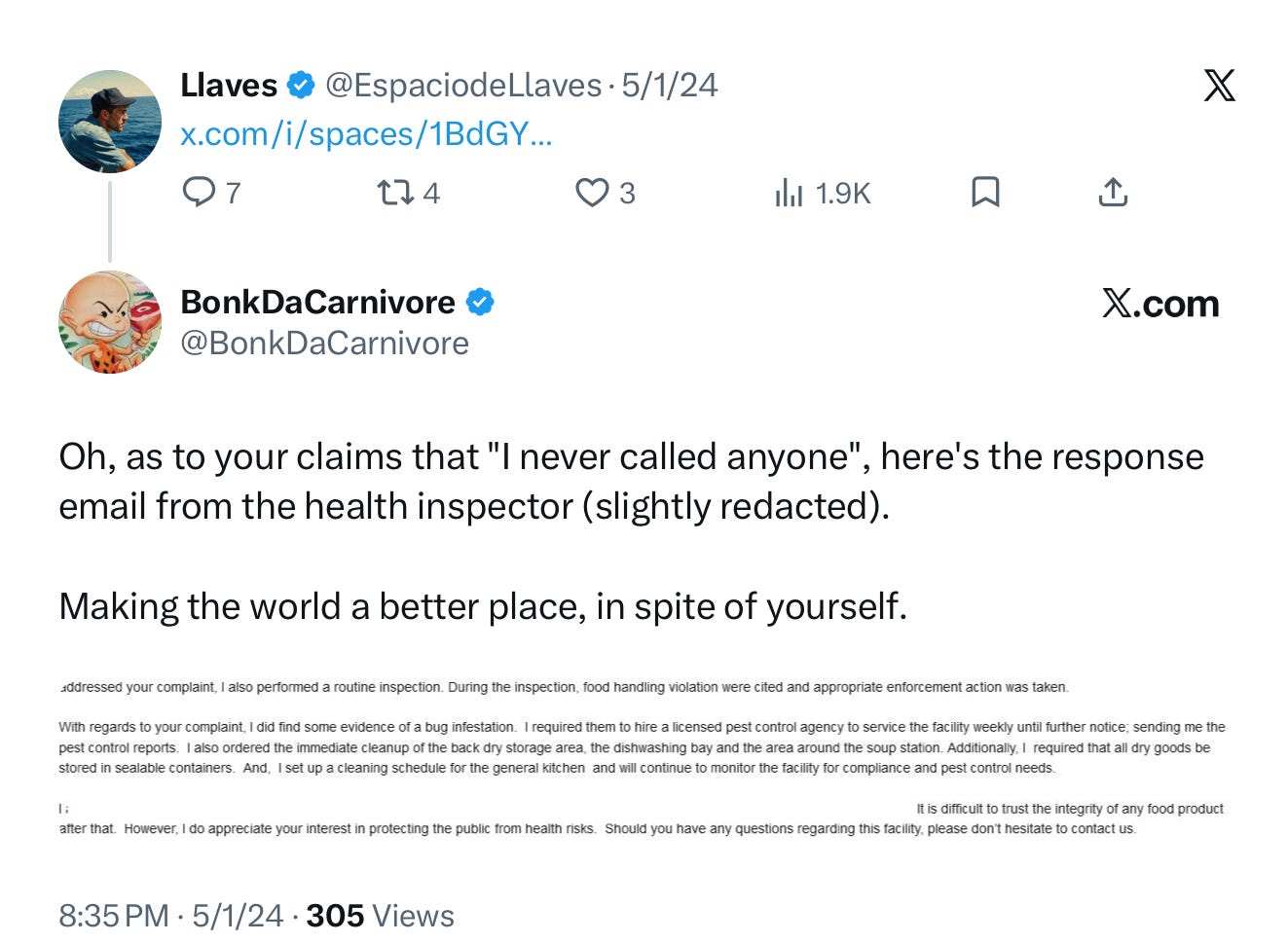
This was Dennis’ own Kafka moment since…well…he doesn’t even own a bar. Yet Bunk nonetheless presented an email that supposedly documented the shutdown of a bar Dennis says does not even exist.


Fed up with the stupid games, which included Bunk threatening others in their circle with doxxing and other forms of harassment, Dennis decided to dox Bunk himself via several posts tying Chance Daniels to the biggest LARP in FinTwit history.
Rather than list everything here, I’ll simply point to the surviving threads and posts Dennis made in his pursuit to unmask Bunk.

I say surviving because one of Bunk’s favorite tactics is weaponizing a lazy, permissive system to his advantage by submitting numerous DMCA takedown notices.
A DMCA takedown is a process through which a copyright holder - or someone claiming to be one - asks an online service to remove allegedly infringing content. Much more interested in their own skin, platforms have a strong incentive to remove content quickly to preserve their legal protections without adjudicating the matter themselves.
Assessing whether a copyright claim is legitimate takes time and money, which allows bad-faith complainants like Bunk to suppress material and leave the target to fight for its restoration.
The catch is that challenging such a notice initiates a legal process that generally requires a formal counter-notice containing the user’s real name, address, and phone number, which the platform forwards to the complainant, thereby turning a bogus copyright claim into a potential tool for unmasking an anonymous critic.
This is a trick of the trade that bad actors like Bunk abuse in service of their own malicious pursuits. And multiple purported infractions can lead to a permanent ban from said platform, leaving users reluctant to post what could otherwise be totally legitimate investigative material. I’m exercising such restraint here, knowing full well Bunk will do everything he can to suppress this post.
Dennis was subjected to multiple such complaints - mostly relating to a high-end Geek Chic gaming table and demonstrated appreciation for Rodney Lough photography that Chance and Bunk happen to both share - hence why certain of his posts have been removed.
Not because X cares about anyone’s safety, mind you, but because X is only concerned with avoiding its own responsibility for anything.
I got hit with one as well when a reader sent me a link to a YouTube video that Chance Daniels posted himself as part of a legal dispute with a dog breeder.

My post linked to a public YouTube clip from roughly seven years ago that included a voice that passed as a dead ringer for Bunk’s.
The clip was removed by YouTube shortly thereafter for copyright reasons, apparently.

All of which begs the question: Why would Chance suddenly feel compelled to remove a video he posted himself years ago? What exactly is he seeking to protect here?
The recording sat publicly available for seven years. Only after I linked to it did he have his own upload removed. Apparently, the video was fine until people started listening to it.
And why use a copyright complaint rather than simply delete his own upload? I can’t establish his reason, but the timing is conspicuous. Either way, why would Chance even care, again, if he’s not Bunk?
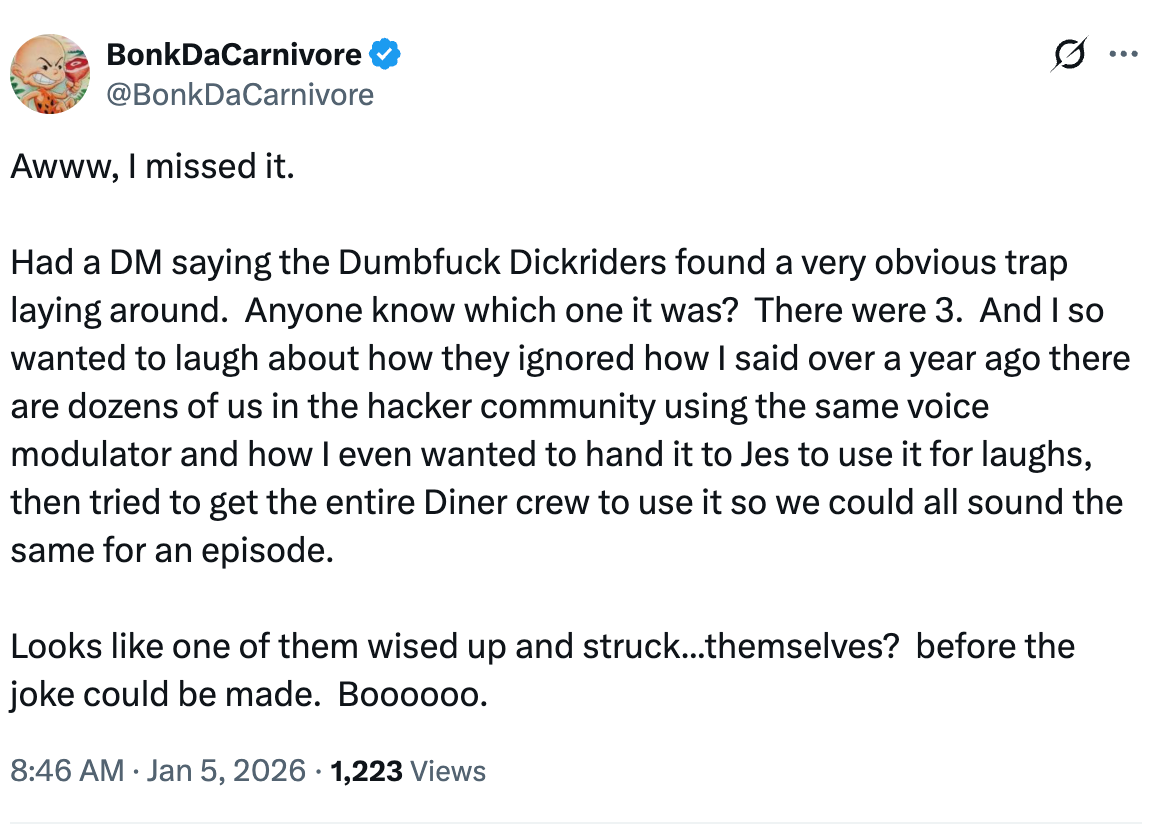
Not to worry, though. As usual, Bunk had a handy retrospective explanation for it all. I walked into a trap, you see. One that Bunk apparently had Chance set…seven years ago. And yeah, Chance was using a voice modulator…the same one Bunk uses now…while speaking with a familiar person…in a private capacity…as one does.
Things took a turn for the macabre when - lashing out against the beatdown he was receiving on FinTwit and bristling at Dennis’ own doxxing of him - Bunk took out his frustration by scraping the bottom-most part of the integrity barrel. Not just by countering his dox by revealing Dennis’ name and location in return, but also by publicizing the fact that Dennis had tragically lost his son to drug addiction.
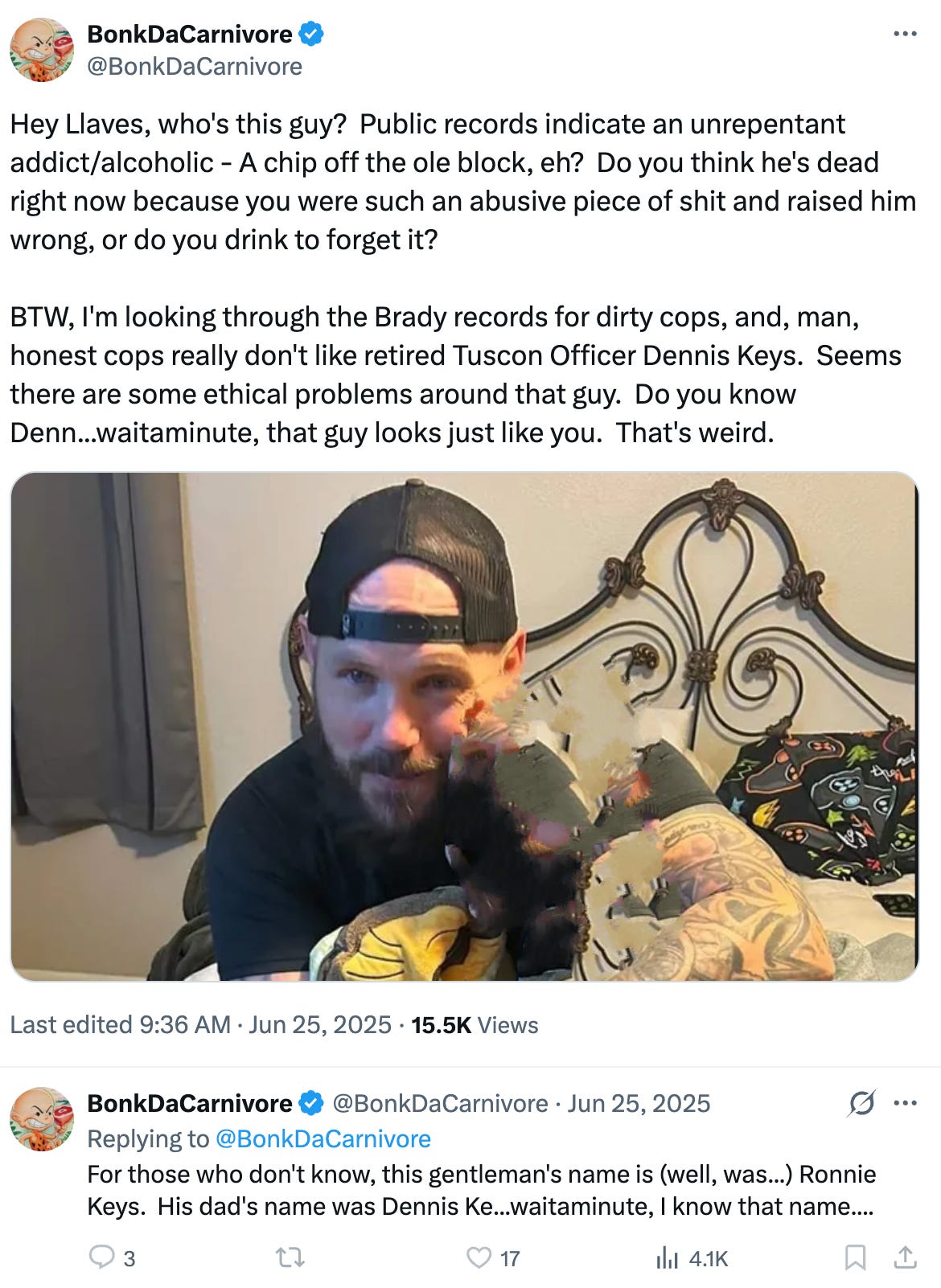
Think about the moral bankruptcy involved here. Bunk used a young man’s addiction to mock his memory and invited a grieving father to consider himself responsible for burying his child.
Just consider the sequence of choices involved: finding the photograph, composing the taunt, publishing it, then returning to make another joke about a dead man’s name.
There was time at every step to reconsider what he was doing. But he kept going.
It takes a particular kind of depravity to look at a father’s dead son and see an opportunity to win an argument on the internet.
As much as I despise this cretin, never would I seek to use the loss of a family member in furtherance of some online beef.
And to those 17 likes from lobotomized losers who aren’t Bunk’s own sock puppet accounts (of which we suspect there are many) - you can fuck all the way off.
This set off a chain of events that I’ll try to concisely summarize here.
Bunk claimed no knowledge of Chance, whose identification naturally came as a complete surprise. But they became fast friends, with the two regularly chatting to discuss this whole affair. Bunk took to calling him the “victim” and his “champion” as he dutifully kept all of X posted on his version of developments.
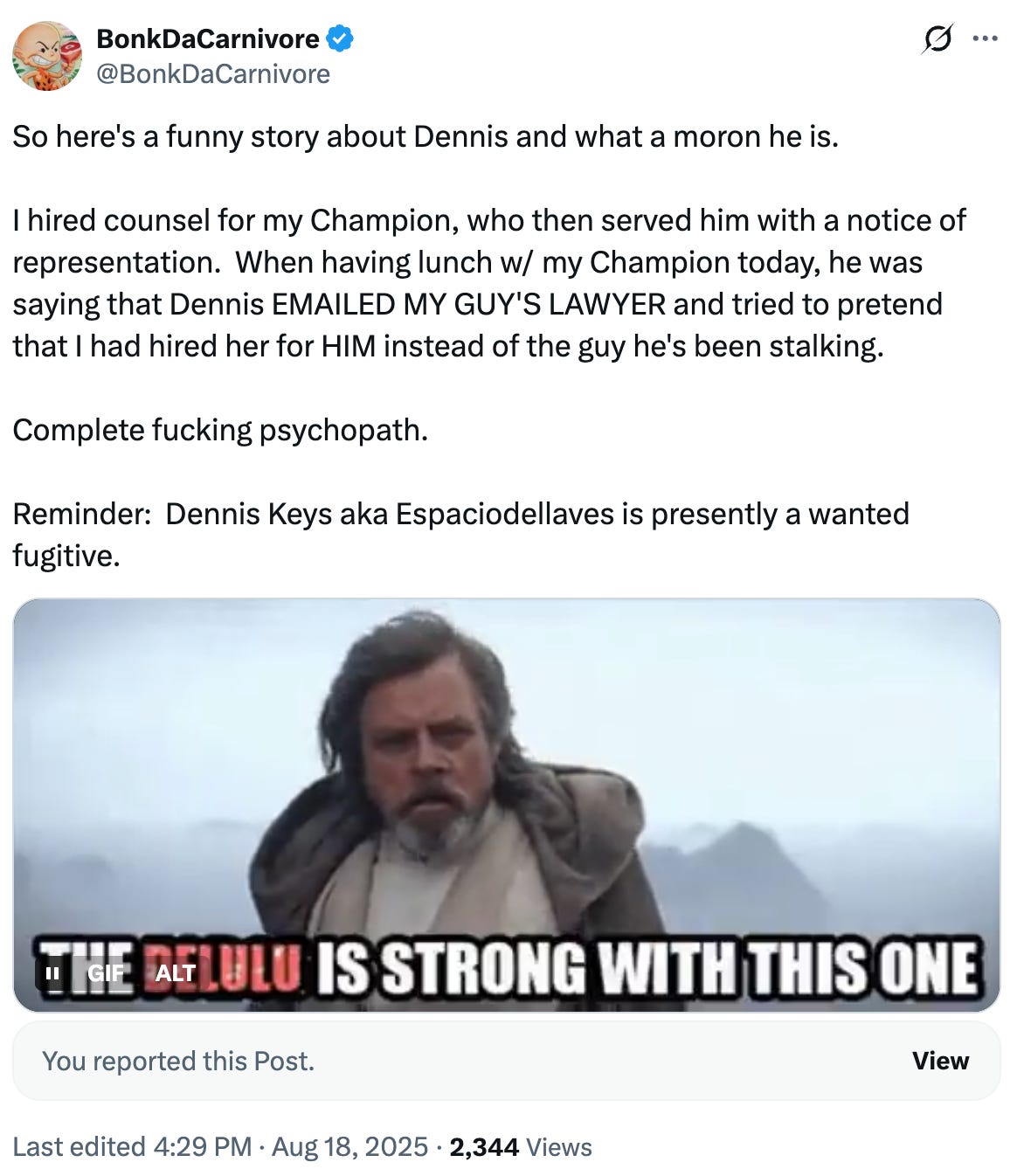
And what do you know? The more Bunk learned about his champion, the more impressed he became.
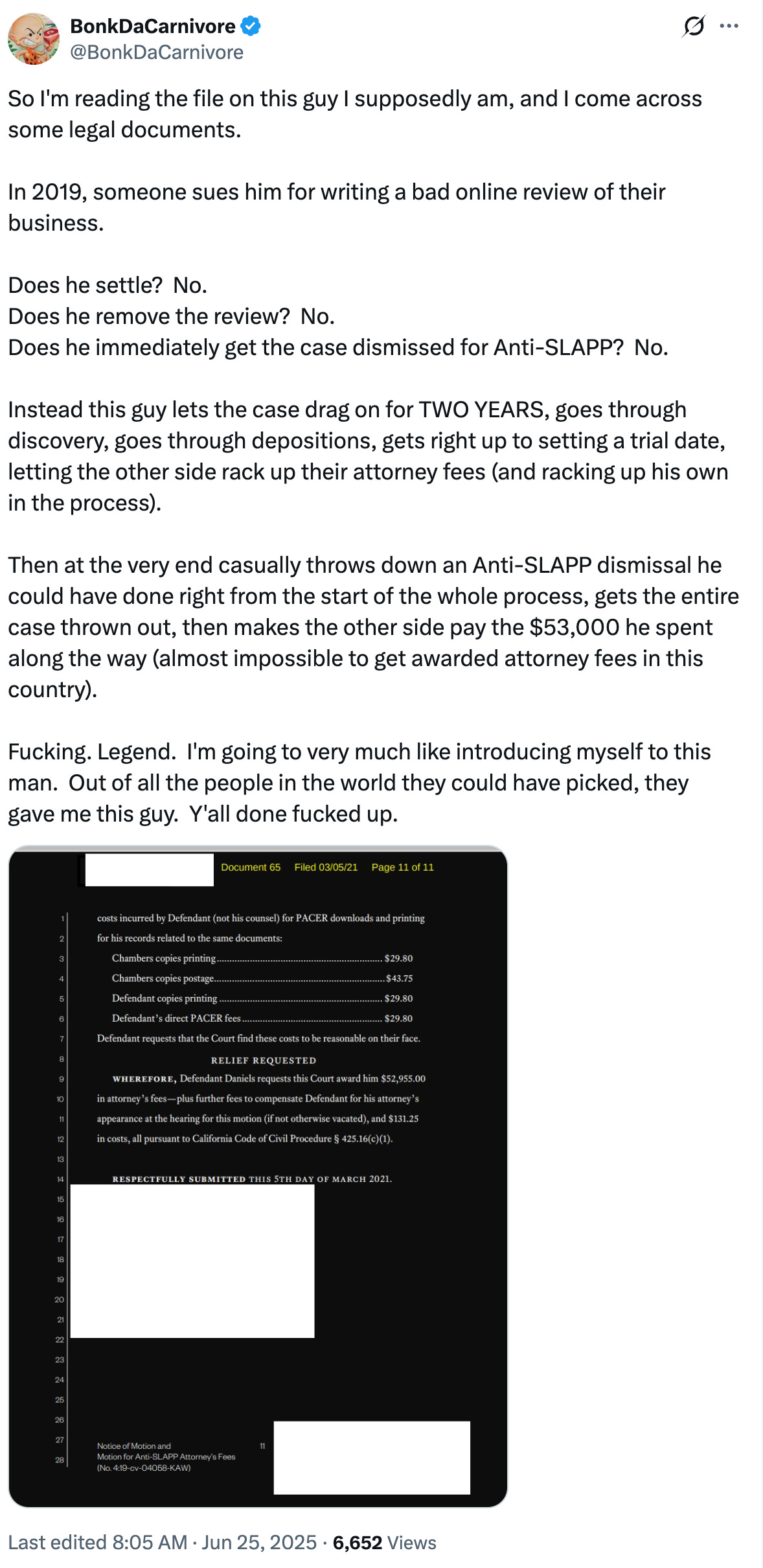
The most impactful development came when Dennis was presented with a protective order on behalf of Chance, delivery of which Bunk felt compelled to blast all over X.
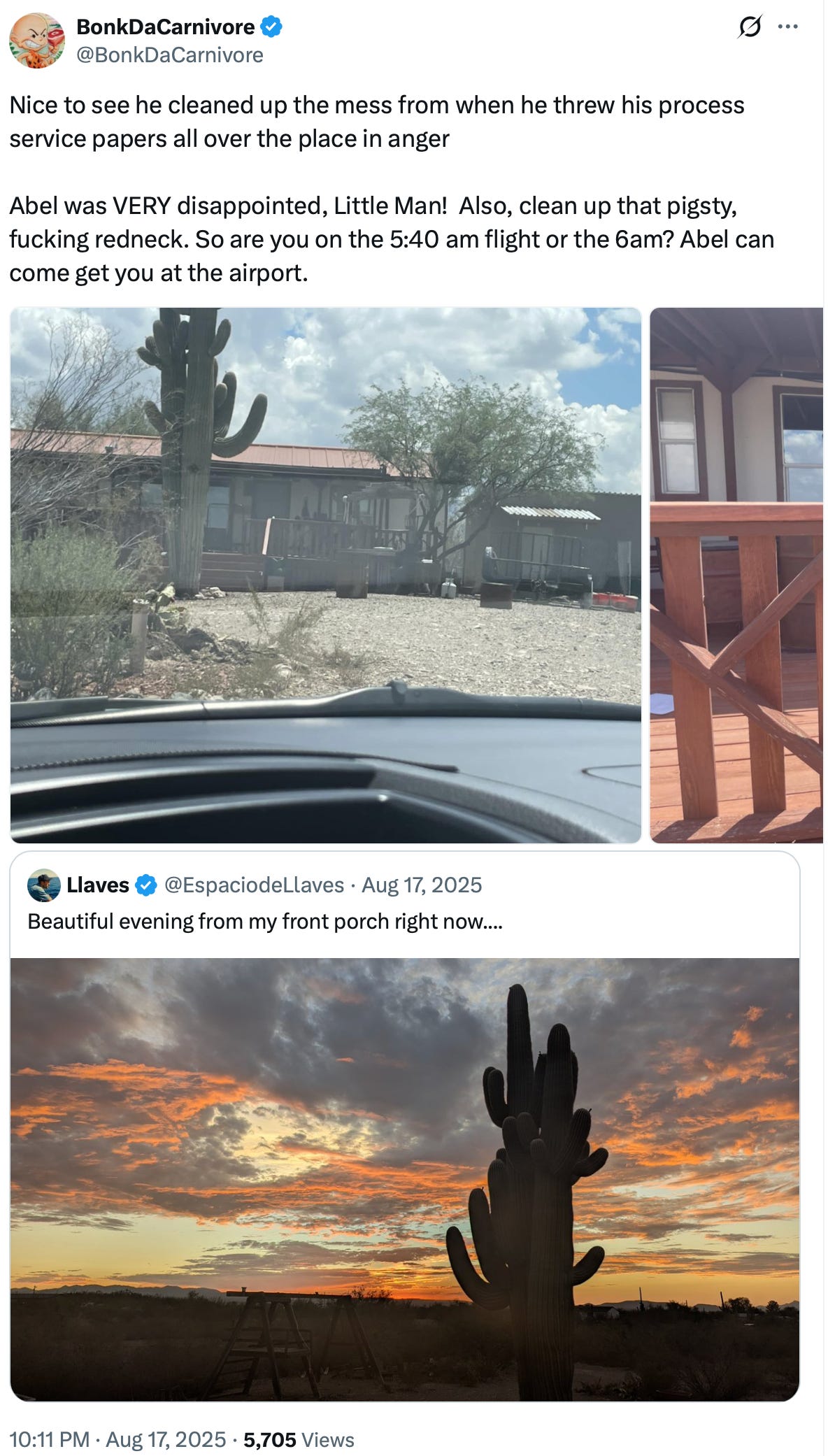
Think about how bizarrely unprofessional, deranged, and unethical one has to be to pull off such a stunt. Bunk marked the service of that order by posting photographs of Dennis’ home, mocking his alleged reaction, and asking which early morning flight he would be taking - adding that “Abel” (a security guard Bunk claims to employ) could meet him at the airport.
The effect is unmistakably menacing, with Bunk using an ordinary legal procedure as an opportunity to advertise access to another man’s home and imply knowledge of his movements. For someone so loudly aggrieved by intrusions into his own privacy, he appears remarkably comfortable turning someone else’s into a public intimidation prop.
In his protection-order application - which I have seen but will not share here as I am not party to the case - Chance accused “Dennis Keys or his associates” of publishing his personal information, encouraging violence against his family, and contacting his business to get him fired, all while insisting they had mistaken him for someone else online.
He also alleged threatening visits to his home, a severed sheep’s head left on his doorstep, and an email containing a photograph of his open garage accompanied by a warning about rape and murder.
The most recent allegation concerned an August 3, 2025 motorcycle incident. Chance claimed a driver resembling photographs he had seen of Dennis pursued him, struck his motorcycle, and caused him to crash, sustaining injuries and damage to the bike. He repeated that account in a submission to the sheriff’s office.
In Bunk’s retelling of the events, they amounted to attempted murder.
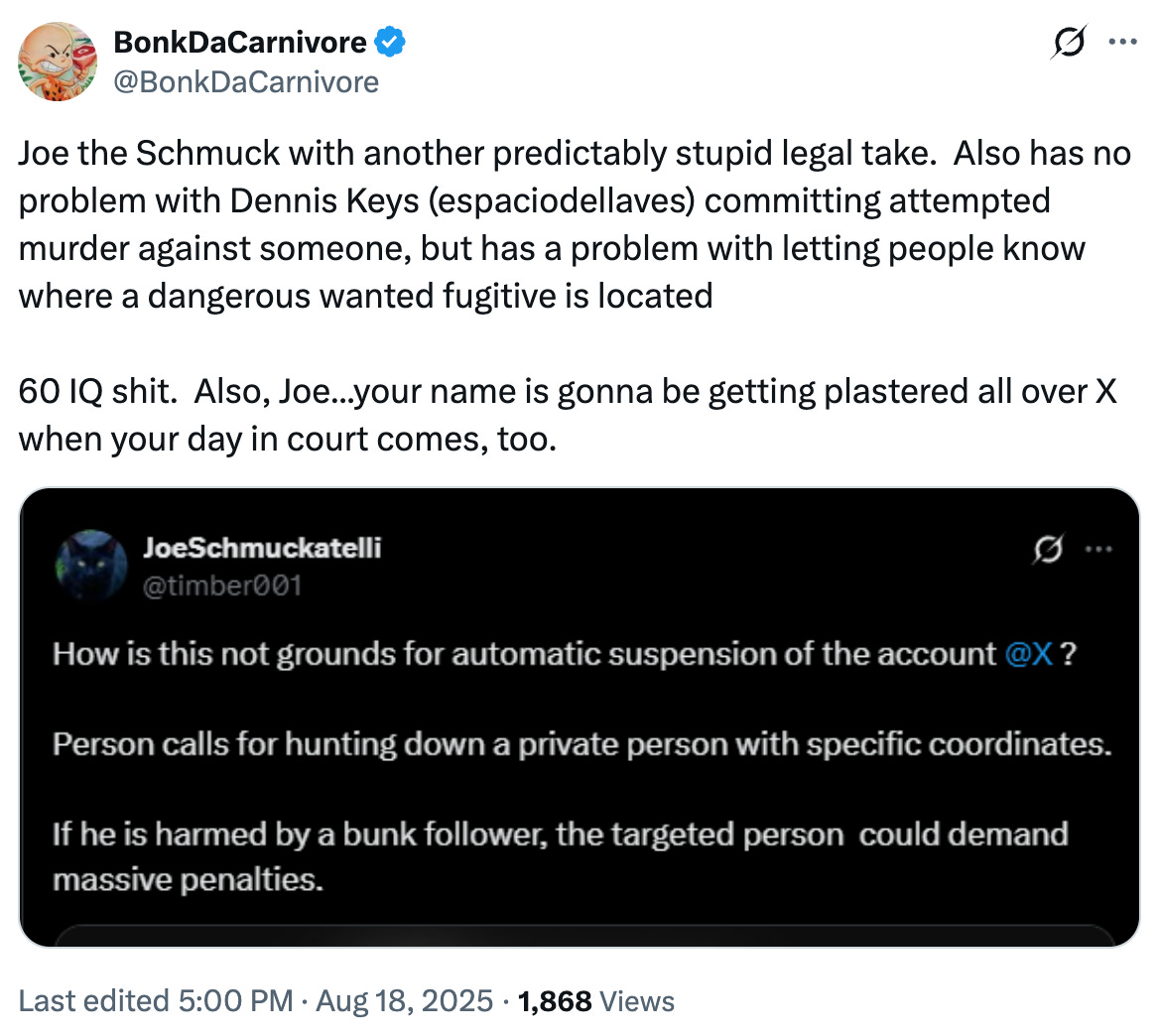
How did Chance know it was Dennis who ran him off the road beyond perceived resemblance? Apparently it’s because Dennis was kind enough to identify himself in the process, a story Bunk told separately on a Space. That’s awfully convenient, innit?
The materials I reviewed contain Chance’s allegations, but I found no independent corroboration of these incidents. No videos. No photos. Nothing beyond Chance’s own reporting of events.
It’s also worth noting that Chance submitted an apparent online incident report to the sheriff’s office repeating his motorcycle allegations. The document contains only his own account, with no indication of an on-scene police response or independent verification of anything. Also convenient.
This served as further confirmation for me, as the elaborate storytelling reinforced my existing suspicion that Bunk and Chance were the same person. The over-the-top theatrics, the high-drama intensity, the lack of any substantiation. Having Dennis drive all the way from Tucson to run someone off the road is already a stretch, much less advertise his guilt to the “victim” by screaming out his identity in the process, then going to find a sheep, chop off its head, leave it at the guy’s doorstep, and take a photo of an open garage to later send via a threatening email.
This is the kind of dumb shit people do in movies just to seed the plot and feed the tension. I mean seriously, folks. A severed sheep’s head?!
Chance is apparently out here living the suburban version of The Godfather, leading to allegations that formed part of his application for a restraining order. This despite Dennis reportedly having never attempted to contact anyone related to this beyond his interactions with Bunk on X.
Convinced Chance had submitted false police reports to justify his restraining order, Dennis went about contacting local police and court officials to let them know about it. He went so far as to offer his cell phone records, car GPS data, credit card history, and even an affidavit that Dennis said would establish he was nowhere near Aurora on the date in question.
In yet another example of institutional failure, Dennis was offered little help from any of the Aurora Police Department, Arapahoe County Sheriff’s Office, or the Arapahoe County Court.
Meanwhile, Bunk continued to lose his mind on X by repeatedly claiming Dennis to be a FuGiTiVe, apparently because he failed to appear to challenge Chance’s protective order and had violated said order “oVeR 70 TiMeS!!!!”.


Well, Dennis failed to appear because he was served on the Friday before a Monday court hearing. Whichever process server Chance engaged for that purpose seems to have waited until the very last moment to serve Dennis with those papers, which clearly complicated his ability to respond.
It became apparent that Dennis could benefit from some legal advice. He needed help combatting a protective order he believed was falsely secured, and he wanted to explore possible civil claims as well. Oh, and he also took out his own protective order against Chance, which would make Bunk’s continued engagement with Dennis on X potentially worth investigating on its own.
So we helped Dennis set up a GoFundMe that managed to raise about $15,000. After months of back-and-forth - much of which was spent just getting counsel up to speed on this epic saga - that money ran out pretty fast.
Then, all of a sudden, GoFundMe decided to terminate the fundraiser out of the blue. As is common with these companies, no explanation was given, no right of reply offered, no ability to contest provided. Just an autobot message telling Dennis that his campaign had been terminated.
Thanks GoFundMe!
While I cannot confirm the suspicion, my guess is Bunk once again worked the system by notifying GoFundMe that he had a protective order against the organizer. But that is admittedly pure speculation on my part.
Despite his best efforts, Dennis ultimately had to throw in the towel on a legal process that was going nowhere. Our legal system is much more concerned with getting paid than it is in delivering justice, and the money required for Dennis to make a full and proper run at Bunk would’ve likely cost him upwards of $50,000.
This is how people like Bunk get away with doing what they do. And we have our systems, platforms, and institutions to thank for it.
Look, I’m sure Dennis has made plenty of mistakes in his life. We all have. But he has vehemently denied every accusation that Chance/Bunk have leveled at him.
Regarding the “dirty cop” allegations, I found no disclosed Brady material in my research and no public reporting substantiating Bunk’s allegations. The accusations of domestic abuse and alcoholism also lack any substantiation that I could find.
Dennis of course also denies being a fugitive. Searches of Arizona and Colorado warrant databases, conducted on October 30, 2026, returned no matching results. Bunk has not supplied a warrant, criminal case number, or court finding supporting his characterization here either.
Bunk is of course welcome to provide whatever public confirmation he has of any of his accusations. But he hasn’t. And he won’t.
Because the man lies like he breathes.
Load-Bearing Bullshit
Leveraging the work that Dennis and others had done, we did a little more digging to learn what we could from public records about Chance.
A quick Google search pulled up an article about how a Colorado man of the same name attempted to sue Robinhood and other trading platforms after incurring losses amidst the GameStop drama from a few years ago.
Same name, Colorado, litigious, day trader. Check, check, check, check.
We also found a LinkedIn profile for a Chance D, which proved rather revealing.

This very much appears to be the Chance Daniels in question, as the listed employment history reveals a focus on cybersecurity, shows roles spanning cities in which Bunk has claimed past residency (LA and Seattle), and includes a stint at DispatchHealth.
Turns out there’s a Chance Daniels who sued DispatchHealth for discrimination, alleging the company discouraged him from applying to head the company’s IT department because he was “just another white guy”.
My favorite bit is when it mentions he “was treated like a second-class citizen because of his Christian faith and need for a religious accommodation” while discussing his being banned from certain activities due to his unvaccinated status.
I guess the Bunk costume allows Chance the god-fearing Christian to work out his demons. The article may also explain one of Bunk’s preferred insults.
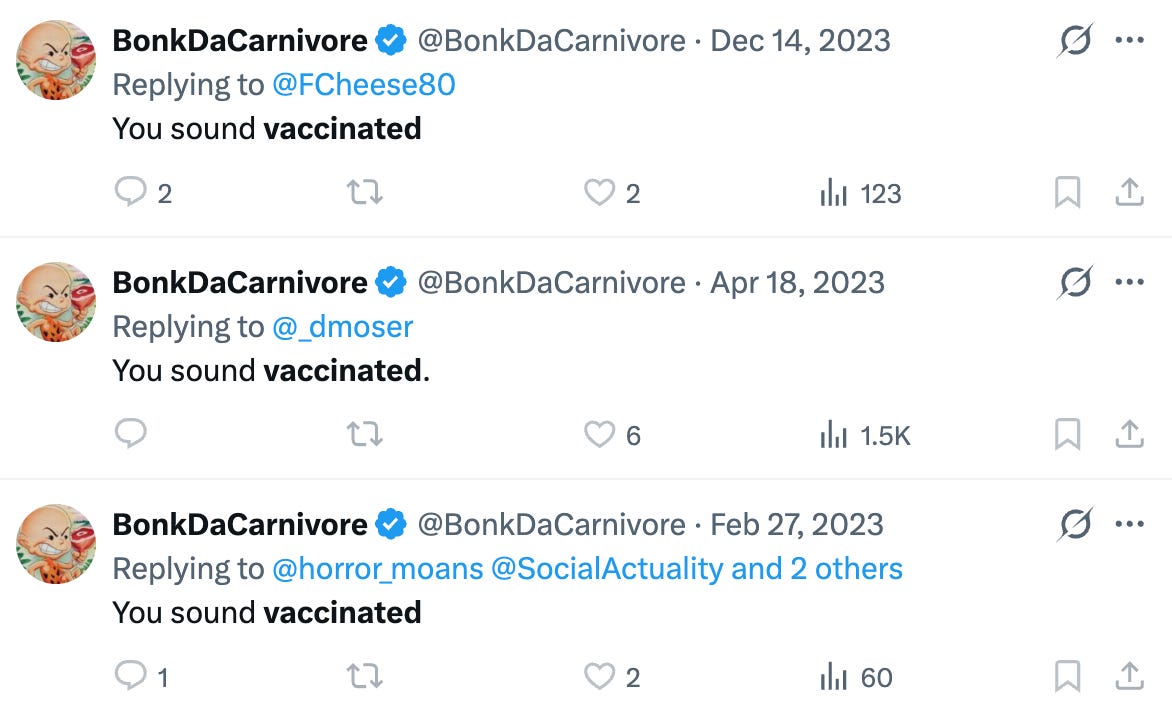
Same name, same company, litigious, aggrieved, hypocritical. Check, check, check, check, check.
Lo and behold, his profile shows no formal academic degrees. Instead, all we see is a lonely mention of some executive leadership program from…MIT Sloan!

Perhaps we should give him the benefit of the doubt here and assume he meant “certificates” rather than “degrees” when he listed his MIT credentials. 😜
His current role is listed as follows:

The company’s website shows it to be a fractional CISO provider. Strangely, its LinkedIn page shows 51-200 employees, but Chance was the only employee profile we found linked to the company’s LinkedIn page.
There’s also a Reddit AMA that attached Chance to Cybercide, where he shares his thoughts as a cybersecurity executive who has led teams of up to nine people in the past.
A business entity search for Cybercide Solutions across multiple jurisdictions generated no results. And despite talking big about its leadership credentials, there is zero information on the website about the executive team. There’s also no address or contact details provided beyond a standard inquiry sheet.
The company repeatedly emphasizes referrals despite providing no named principals, client references, or attributable credentials beyond a generic listing of titles. It feels a bit overwrought, like “you haven’t heard of us because we’re super selective”.
The referral language strikes me as performing the function that named people with demonstrated experience would normally do.
I could easily be wrong here, but my working hypothesis is that this is Chance’s own consulting business, which makes sense. One, I’d imagine someone who sued their former employer isn’t a hot commodity in the job market. And two, it would certainly explain why he’s got so much time to playact all day on X.
Note too how the previously-linked article about DispatchHealth listed his termination being as of May 30, 2023. And when did Chance start at Cybercide? The very next month. 🤔
We kept digging and learned quite a bit more about Bunk’s champion, picking up some tidbits previously missed or recently revealed to the BCU.
In an interesting juxtaposition, Chance appears to have his fair share of financial troubles.
There’s a report of a foreclosure proceeding in 2021. And there’s a case of Capital One suing him for a purported outstanding credit card debt of nearly $40,000.
We also found an interesting coincidence in an older post of Bunk’s where he complains about receiving a speeding citation that just so happened to align perfectly with a public record of Chance receiving a ticket of his own.
We discovered more Bunkflation too.
For example, Bunk’s a Jeopardy champion.
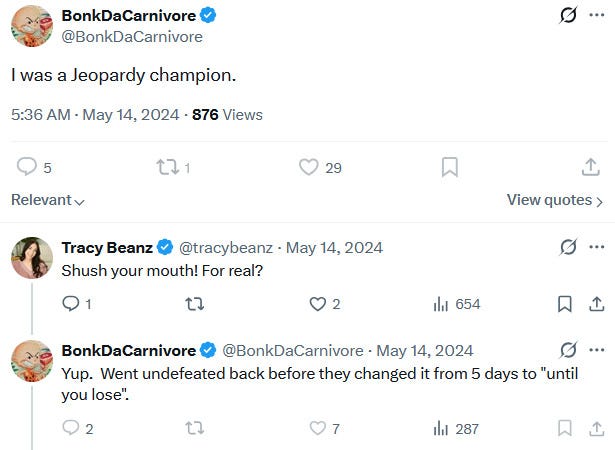
(As an aside, we found no record of a PhD economist from MIT winning Jeopardy either during the period Bunk claims or anytime thereafter.)
He’s a certified divemaster.

He has a ring from the Rams’ Super Bowl win.

He brunches with Fortune 500 CEOs and heads of large trading desks.

We also came across video of a 2024 Black Hat USA conference - an annual event Bunk mentions with some frequency on his timeline - that features a man who looks conspicuously similar to Chance practicing his lock-picking skills (hope he got that neck boil sorted).
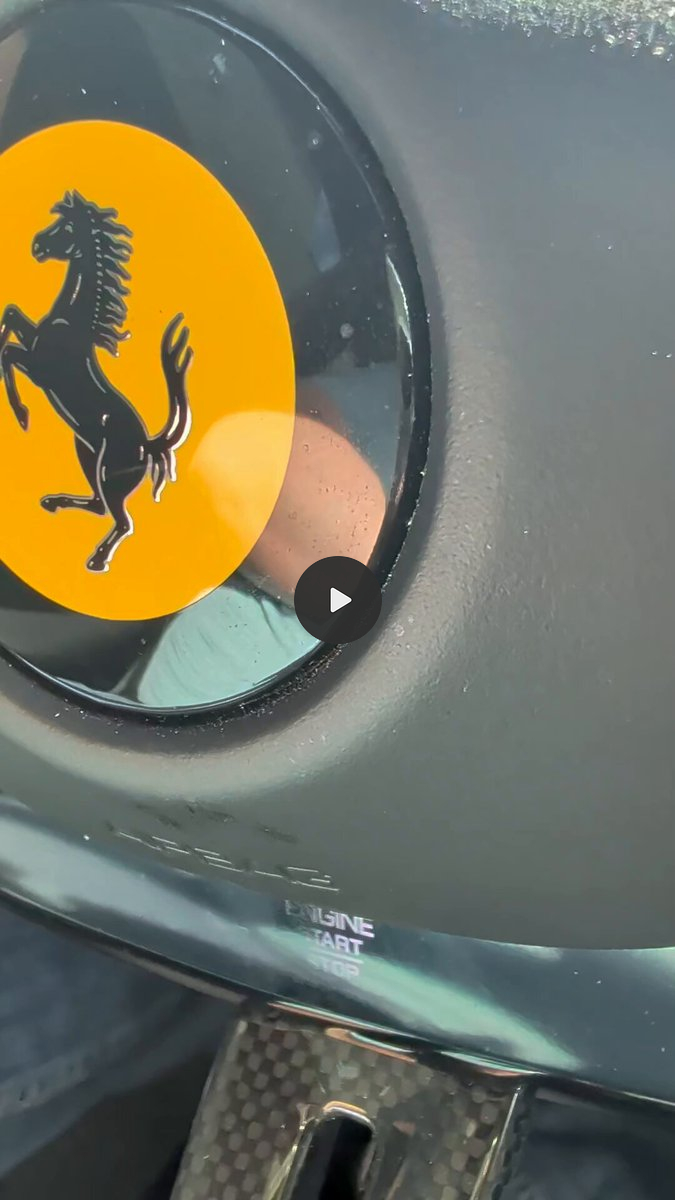
There was also a hilarious back-and-forth with John Cardillo in which Bunk tried to pass off what some speculated were rentals and showroom cars as his own (notice he’s not driving the Roma, which still has protective plastic visible and the odometer blurred out for reasons), all while confirming everyone’s suspicion that if he’s truly of Viking descent, it’s of the overweight variety (notice the labored breathing - which he blames on hypoxia - and rotund silhouette).



My favorite bit was when he attempted to combat the accusation that he’s wearing discount bin sneakers with a video describing how comfortable they were to slide on and off. In the process, we were treated to more slovenly details none of us cared to see, particularly the skin flakes drifting to the ground as he bent over to demonstrate his handy dandy shoe removal.



The walls began closing in well before that, and Bunkruptcy appeared imminent. An extremely strong case tying Bunk to Chance had been made in full view of everyone, which compelled Bunk to finally give up the ghost by confessing that he had coopted another man’s life in order to protect his own anonymity. As billionaires do, I guess.

His explanation is that he deliberately borrowed another man’s personal experiences, adapted them, and presented them as his own to send investigators chasing the wrong person. The similarities we identified were supposedly planted. What looks like evidence is, he assures us, evidence of his ingenuity.
Consider what accepting this explanation actually requires.
We must believe that a man claiming extraordinary wealth, achievement, and distinction spent his very valuable time appropriating a random stranger’s speeding ticket grievance for an anonymous social media account. That he embellished the story with children, a particular vehicle, and political details to make it feel authentic. And that he maintained - or intended to maintain - documentation so he could keep his invented experiences straight.
Imagine Jeff Bezos borrowing some random guy’s Facebook anecdotes to build an anonymous account from which he boasts about being someone closely resembling…Jeff Bezos.
Such elaborate misdirection requires an explanation of its own because why would someone with such an extraordinary life need to borrow the mundane details of somebody else’s?
More damning still, the supposed deception reached everyone reading the account. His followers received the same manufactured autobiography as the people he now calls bad actors. They were given no means to distinguish sincere personal disclosures from planted fiction. And he now mocks others for believing material he apparently expected his own audience to accept.
This is where the persona begins to collapse under the weight of its own defense. Bunk is asking readers to trust his account of why he cannot be trusted. We are supposed to accept that certain personal stories were calculated fabrications while continuing to credit the credentials, accomplishments, and wealth claims that make the character worth following.
On what basis? His assurance that those parts are real but everything else isn’t?
The scaffolding becomes especially visible in his instructions to document invented stories. He explicitly describes the need to preserve details so they can be reproduced years later. Under this explanation, a consistent story need not reflect a remembered experience, but simply a well-maintained script.
And each difficulty requires another supporting explanation. Matching anecdotes become deliberate bait. Altered details become evidence of sophisticated adaptation. Failure to remember the fiction gets an explanation involving lost documentation.
Even directing scrutiny toward an allegedly uninvolved person is presented as a clever privacy measure, followed by indignation that anyone pursued the connection he claims to have engineered in the first place.
Amidst all of this, we’re meant to believe that this innocent man, Chance Daniels, has no problem with some rich guy pretending to be him out of nowhere?
Notice how we’ve received no word from Chance himself during all this, beyond of course his name being attached to legal documents and DMCA takedown notices. But I guess he’s totally cool with Bunk despite all these headaches?
The least I’d do is request my strange new billionaire friend to help settle my debts.
None of this keeps Bunk from shadowbarking, of course, with him talking all sorts of trash from behind the block while his mindless seals clap for him in the comments.
Meantime, I’ve done my part by reaching out to various authorities and institutions to see if anyone out there might give a shit about what this weirdo is up to.
I reached out to X multiple times to report his cyberbullying and harassment. But we all know X under Elon Musk gives zero shits about user safety and platform integrity, so that was always a losing game.
I notified the Colorado Supreme Court of an individual claiming to be a member of their state bar while flexing legal credentials online.
I informed FINRA that we have another anonymous furu operating within that social media gray area of kinda sorta dispensing financial advice while also implying regulated status (trading on the floor of the NYSE requires registration).
I alerted the Coast Guard to an individual parading his search-and-rescue bona fides online while in the process bringing nothing but shame and dishonor through his antics.
I notified MIT that there is a man dragging its name through social media given his outrageous antics.
I also reached out to big media - namely, the NY Times and Wired Magazine - to shop a story that reminds me very much of the Netflix documentary Don’t Fuck with the Cats (minus the murder, of course!).
As far as I can tell, each of these outreach attempts fell on deaf ears.
Knowing no formal consequence will come Bunk’s way, I’m left writing longform content like this in hopes that part of Bunktard nation might finally see the light.
Which brings us back to that Kermit-sounding former sycophant, Croaky.
My focus has always been on Bunk, so I paid Croaky’s ankle-biting little mind in the moment. But he provides an opportunity to meditate on some other dynamics of social media at play here.
I’ve been told by fellow sleuths that Croaky has no experience in investment management and instead makes his living doing blue-collar work miles away from high finance.
Look, I’m not one to belittle the professions of others. There’s honor in any (legal) work that provides for one’s family. But - assuming Croaky’s professional background is as described - to overstep in such an extraordinary manner is just so bizarre to me.
It’s less about assuming the worst of anonymous actors online. I certainly sympathize there and tend to agree with the default skepticism. But to speak with authority on a topic well outside my wheelhouse while challenging someone who could very well be an expert on said topic is just so strange to me.
I mean, if someone claiming to be a Green Beret wrote a piece challenging my buddy whom I know to be a Green Beret, the last thing I’d be compelled to do is show up to that author’s space (in my buddy’s stead, mind you) to challenge his understanding of Green Berets. That’s because I’m not a Green Beret. And I remain possessed of a certain epistemic humility so sorely lacking in our modern discourse.
If I don’t know something, I don’t act like I do. If I don’t have something, I don’t claim to possess it. If I’ve never met someone, I don’t profess to know them.
Less than the guilt I’d feel about openly lying to others, knowingly lying to myself would be an epic display of self-defeat. Purposely misleading others about my own experience and capabilities would be admitting that my actual self is insufficient.
This, sadly, makes me a bit of an outlier in the hellscape we call X.
If I could draft the rules of engagement for our online lives today, they would read something like this:
Be confident about what you know.
Be persuadable about what you think.
Be curious about what you don't know.
In a twist that should surprise no one, Croaky and Bunk eventually had their own falling out. This happens with some frequency when it comes to Bunk and his online situationships.
Cracks in the Crunky partnership emerged back in March when these loud and proud armchair politicos clashed over Florida’s gubernatorial race (as an aside, I’ve discovered through this process that Florida state politics might be the most batshit crazy version on offer in America).
I linger on Croaky here for two reasons: 1) As mentioned, I’m amazed at the chutzpah from an anthropological standpoint; and 2) It makes me wonder what it might take to change the minds of other Bunktards.
Surely, the preponderance of evidence on display would cause any logically sane person to at least land on disinterest if not disgust with this character. Instead, it took Bunk insulting Croaky personally (status, manhood, etc.) for him to finally come around to the fuckery at hand here.
Rather than some revelatory moment, it well appears that Croaky’s realization was a forced one since it seems to have come only through intervention (Bunk attacking him) rather than inspiration (Croaky being convinced otherwise).
This provides a wonderful study in selective skepticism, motivated reasoning, and identity protection. When the evidence threatened an ally, Croaky not only discounted it but used it as fuel to launch his own offensive in defense of an anonymous character he knows little about. When the same evidence became ammunition against a newfound adversary, he happily deployed it.
Croaky wasn't applying a consistent evidentiary standard and arriving at different conclusions as new facts emerged. His apparent standard for evidence changed along with his relationship to Bunk. Croaky didn't just change his mind when Bunk attacked him, but he also changed his assessment of evidence that already existed.
Sometimes people don't reject evidence because they find it unconvincing but because accepting it would require them to reject something or someone they're motivated to protect.
This sort of myside bias is prevalent on social media. People evaluate arguments and evidence more favorably when they support their existing position. Evidence against the in-group faces an extraordinarily high bar while evidence against the out-group faces a remarkably low one.
Look, Bunk and Croaky are both smart guys. But IQ just measures horsepower. It doesn’t mean smart people can be good at everything. And it certainly doesn’t account for judgment, which appears inversely correlated with IQ in instances like we have with these two.
I use Croaky to demonstrate not just the travails of misconfidence but also how information integrity can't merely be about making evidence available. We had already done much of that. The evidence was sitting there. The problem was that, thanks to groupthink, Croaky’s social incentives prevented him from assigning the evidence appropriate weight. It took specific personal experience to change which evidence he was willing to believe when that very evidence remained consistent throughout.
Show Us The Money
For all the entertainment value of Bunk Lore, his claims to financial expertise deserve scrutiny of their own. This is where the persona meets the product: pronouncements on finance and investing delivered with supreme confidence, alongside trade callouts offered as proof that we’re in the presence of greatness.
In this section, we examine how well that confidence survives contact with subjects he professes to understand, then put his public trading calls through the Speculah rubric.
We’ll start with his current pinned post, a rather humorous macroeconomic dissertation that provides another unexpected example of something the world’s richest people apparently do: spend days writing a lengthy treatise on the national debt, then publish it anonymously to thousands of random followers on X. Just because, I guess.
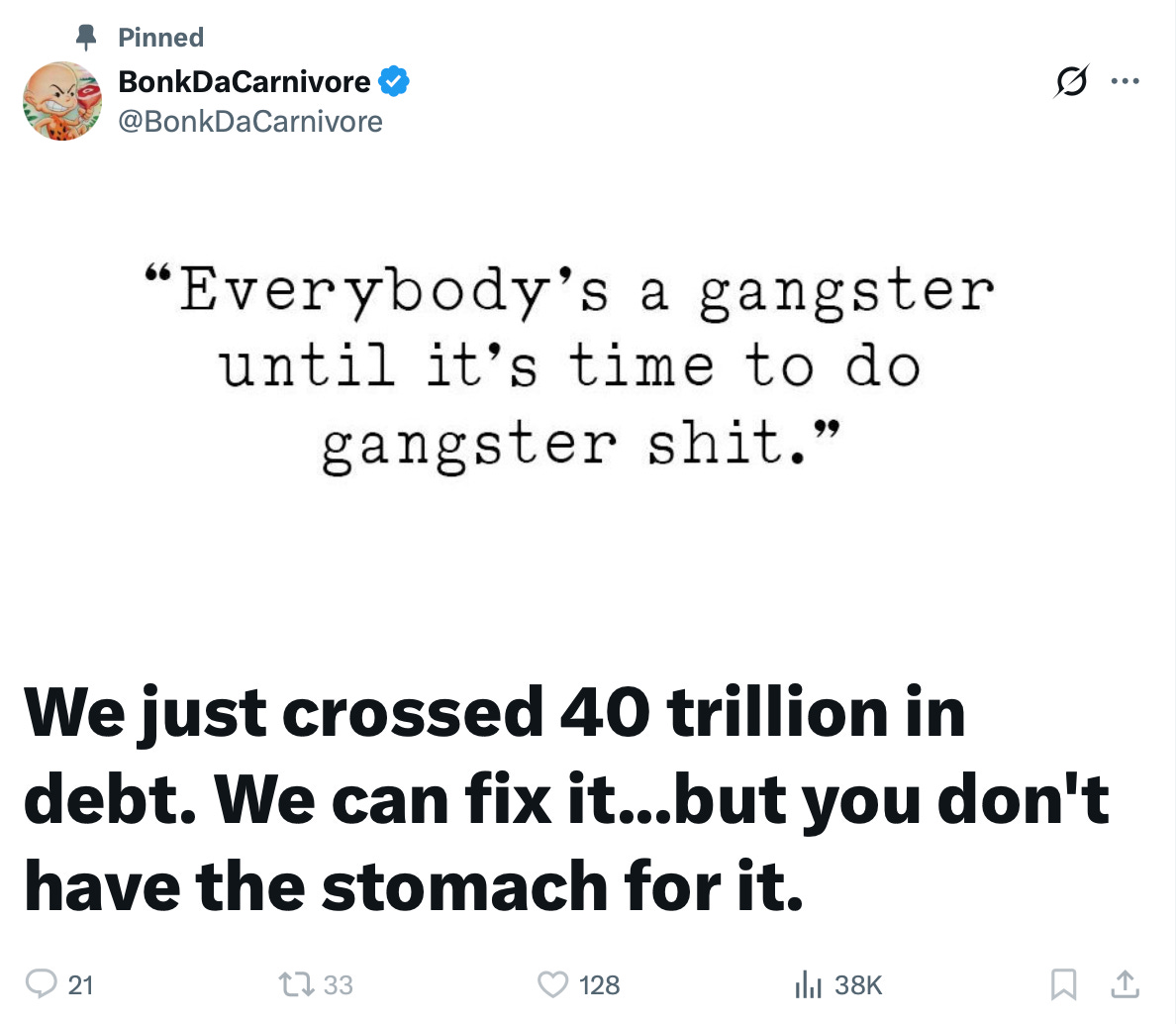
Let’s first enjoy the irony of this header quote juxtaposed against the cowardice of its author, a man petrified to engage with any real pushback against his myriad claims.
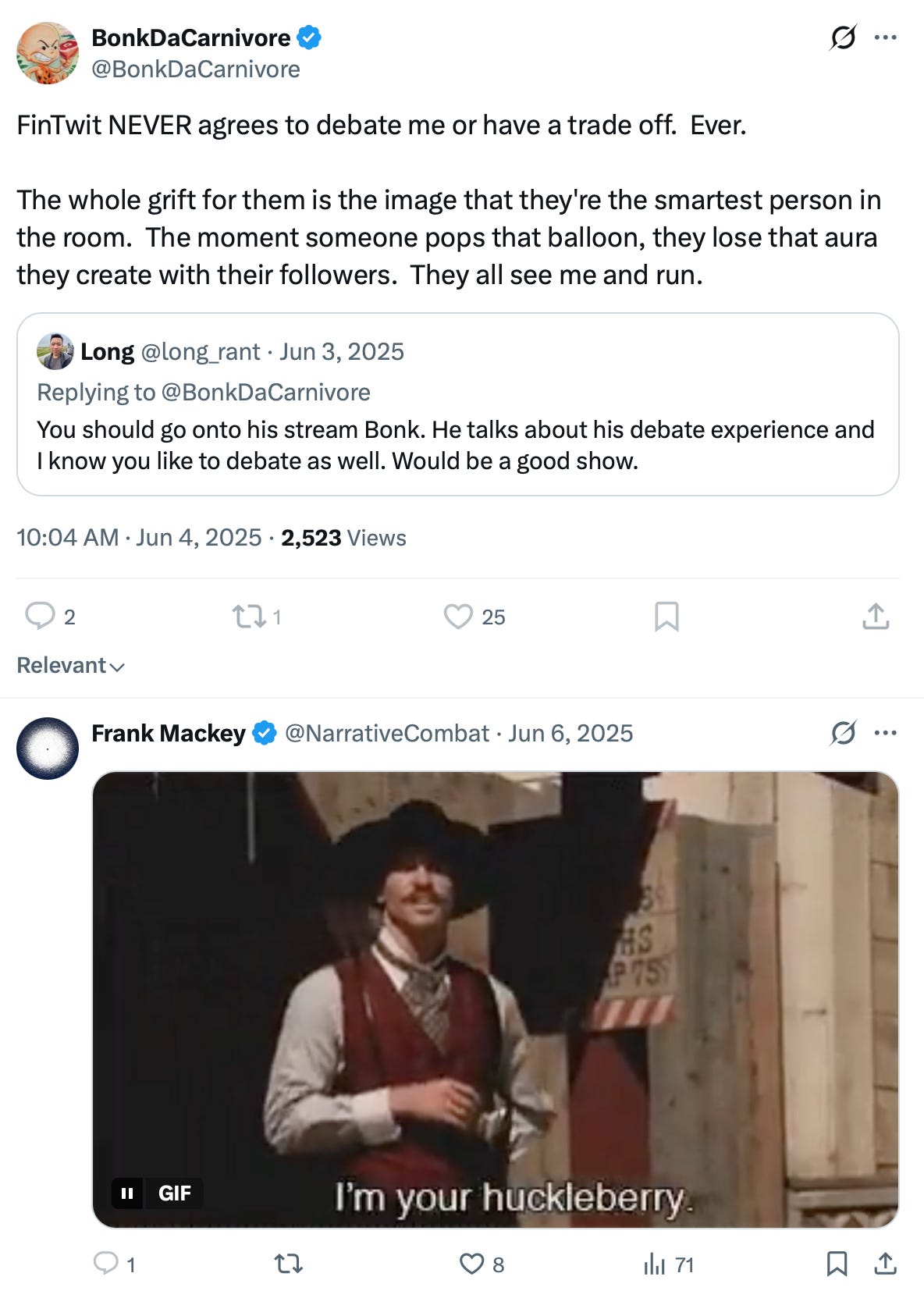
For all the smack he talks, Bunk is deathly afraid to engage with me directly, whether in a Space or on the timeline.
But more interesting is how brazenly he betrays his own ignorance on a topic in which he claims mastery, as his piece is comically littered with analytical mistakes.
Indeed, Bunk’s self-aggrandizing fiscal exercise - which the world most certainly did not need - is a useful example of what I’ve taken to calling Artificial Sophistication: analysis that borrows the vocabulary and precision of expertise without incorporating the conceptual disciplines that make expert analysis reliable.
Many of his ingredients are legitimate - healthcare costs matter, broad-based revenues are necessary, and trivial spending cuts cannot solve a structural deficit - but the assembled product is an incoherent mush.
Without belaboring it, several figures don’t reconcile. For example, his projected debt levels don’t match the reduction he says is needed to reach his target, and his foreign aid estimates don’t support his claimed savings.
Bunk repeatedly jumps from policy proposals to precise forecasts without providing us the calculations needed to connect them. He says he modeled and stress-tested the plan, but we’re given the conclusions without enough supporting work to assess how he reached them. He also describes Medicare Advantage as “a Trump idea,” but the program predates Trump’s presidency by many years.
These problems are visible without reconstructing his entire model or debating his policy preferences. They matter because he repeatedly invokes his supposed expertise to ridicule everyone else’s understanding.
An actual MIT PhD could still make mistakes, of course. But someone with that training would ordinarily recognize that precise forecasts require more than an assurance that the math was done. Readers need enough of the assumptions and calculations to assess whether the conclusions jibe.
The mismatch is the evidence. He produces the appearance of advanced analysis while missing the basic checks one would expect in an argument presented as such. AI can imitate the appearance of subject matter expertise, but it can’t retroactively give its operator the judgment required to truly understand the resulting gestalt.
Such is the nature of Artificial Sophistication: real concepts, recognizable terminology, and precise-looking forecasts that give an argument the appearance of rigor without the supporting calculations needed to establish whether its conclusions hold together.
The resulting work looks pretty from a distance precisely because AI can now supply enough panache to allow posers to casually claim expertise. But the amateurism inevitably reveals itself in the attempted integration of those manufactured parts.
Let’s continue to chip away at his claim to have earned a PhD in economics from MIT, which apparently makes him an expert on tariffs.
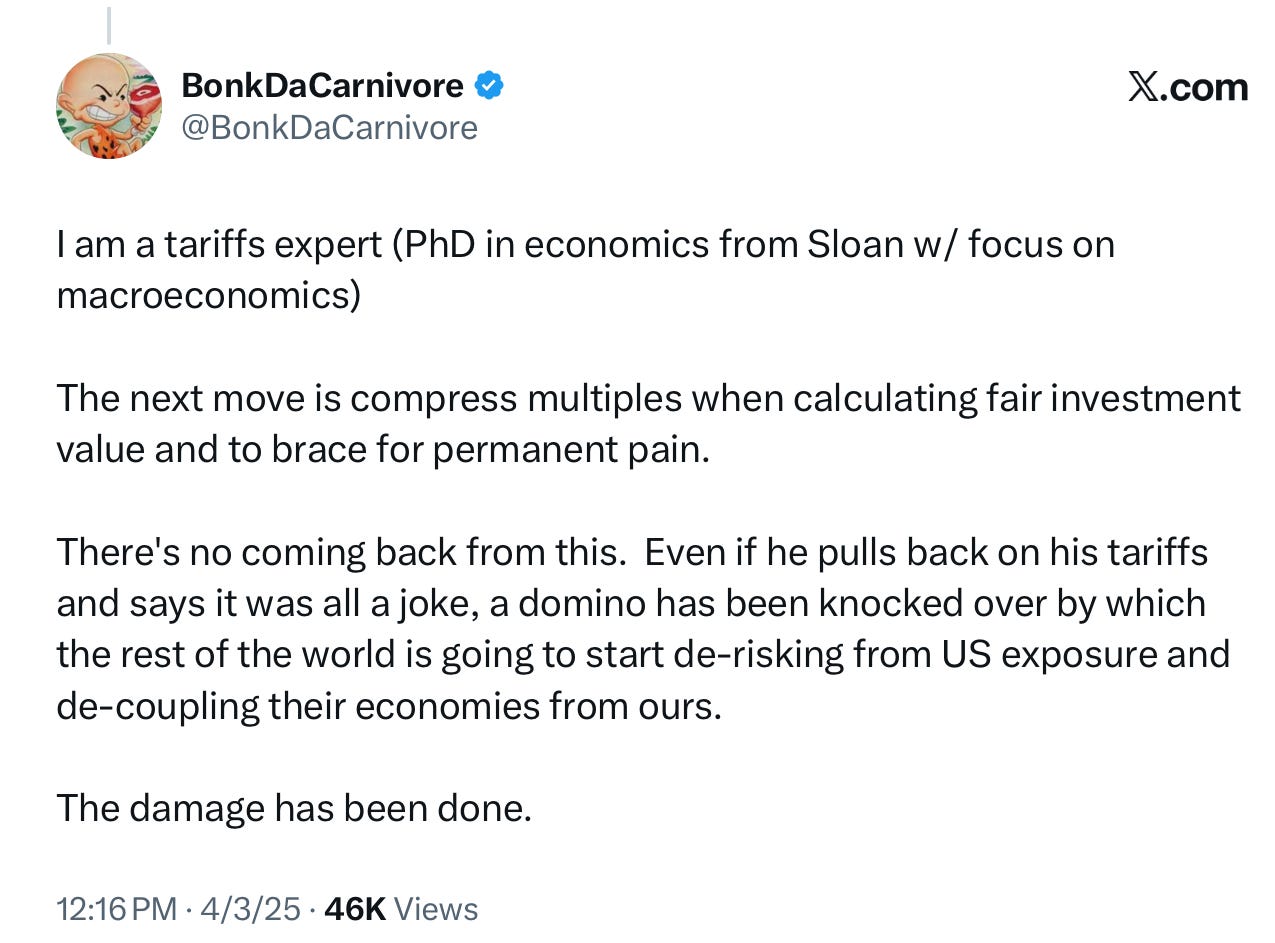
I still find it curious that Bonk claims to hold a PhD in Economics - with a focus on Macroeconomics - from MIT Sloan. Because MIT’s standard Economics PhD is administered by its Economics Department, a separate part of the university. Sloan has long offered doctoral study, including in economics-related fields, but we found no evidence that it ever independently offered the specific Economics PhD Bunk often describes.
Apparently, we’re not the only ones curious about this assertion.
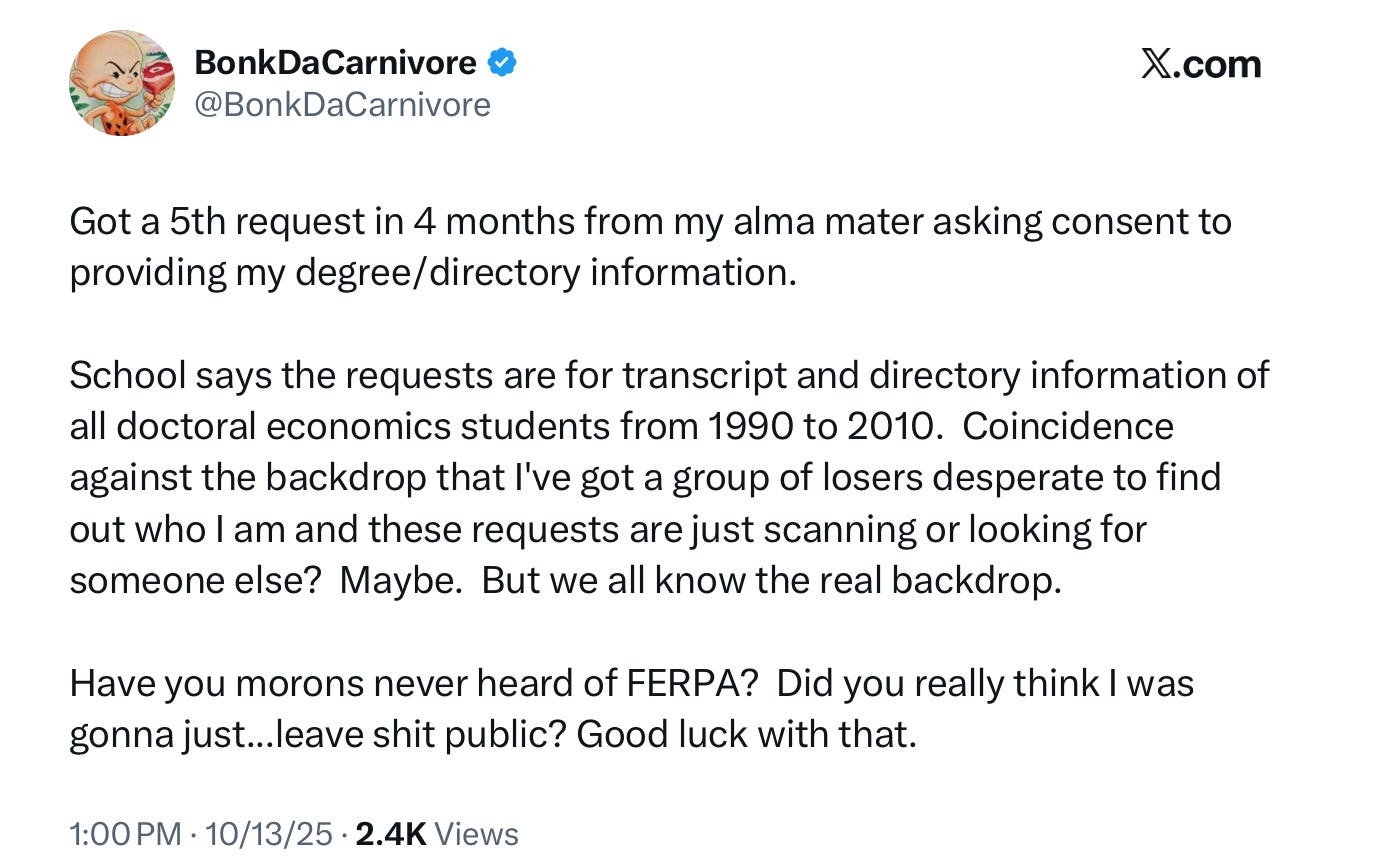
Let the record show that nobody associated with Speculah has ever made any such inquiries.
MIT’s own policy states that only current or former students can request their transcripts and that it accepts no third-party transcript requests. A request for the transcripts of every economics PhD student over 20 years would therefore run straight into MIT’s published policy on the topic.
The referenced post does two things at once, providing yet further evidence of the narrative scaffolding Bunk often employs: it implies MIT has records confirming his claimed doctorate and supplies a ready-made explanation for why nobody can verify them.
It’s a clever little loop that basically says:
The university contacted me because people are looking for my records. The records are private because I made them private. And the fact that people can’t find them proves my privacy measures are working.
But the only evidence of the university ever contacting him is his own account. He’s using one unverified claim to bolster another.
It also preemptively reframes a failed search as something to be expected rather than reason for skepticism. And by describing the supposed request as covering every economics doctoral student over two decades, he adds a persecution narrative. His enemies are so desperate to unmask him that they’re demanding an entire generation’s academic records.
“MIT won’t let you see my records” is doing a lot of work for a man who has yet to establish that MIT has any records to hide in the first place.
Also, earning a PhD in economics doesn’t automatically make one a “tariff expert”, just like my MBA doesn’t make me an operations expert. A macroeconomist could certainly study the aggregate effects of tariffs on inflation, output, exchange rates, or monetary policy, just like I studied things like throughput and bottlenecks during business school.
But just like with business, macroeconomics is a vast field. Expertise in tariffs would depend on what he actually researched or worked on. You know, things like trade policy, international trade, supply chains, tariff incidence, and other related subjects. That requires a different kind of specialization, which is why MIT lists International Economics separately from Macroeconomics as a focus.
Lastly, economics departments tend to operate as literal schools of thought, which often sees them develop or adopt certain philosophical tenets to serve as basis for their study.
This makes the following post rather perplexing:
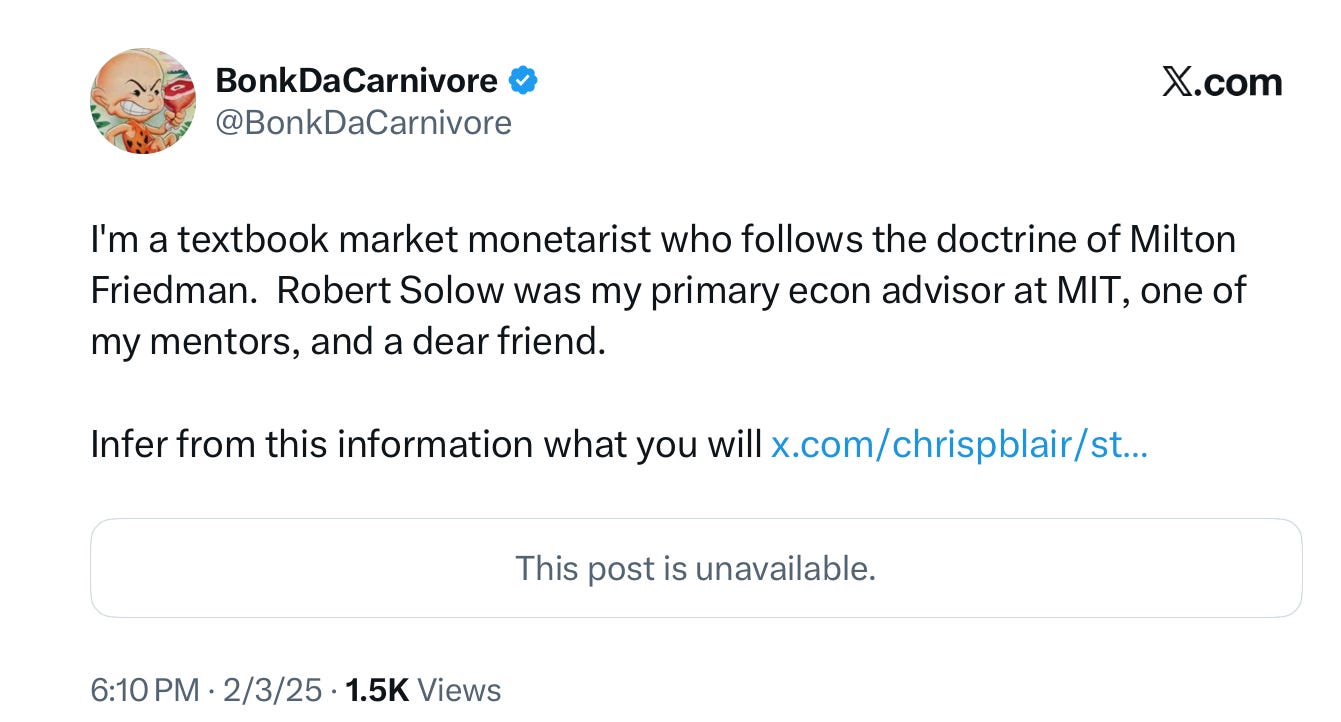
Infer we shall.
Bunk describes himself as a “textbook market monetarist” who follows the doctrine of Milton Friedman. He also claims that Nobel laureate Robert Solow was his primary econ adviser at MIT as well as mentor and dear friend.
That’s an interesting pairing. Solow was a leading figure in MIT’s Keynesian tradition and a prominent critic of Friedman’s monetarism. The two men represented competing approaches to understanding the economy and the role of monetary policy.
Students are, of course, free to disagree with their advisers, but Bunk’s claimed intellectual journey would be an interesting one to hear about given its oddness.
One would think that Solow might’ve gushed about having a rebellious monetarist student who went on to become an uber successful venture capitalist and one of the world’s wealthiest people. We searched for that combination in coverage of Solow and his former students but failed to find a quip or account matching it.
What we did find is an extensive public record of Solow’s mentorship. MIT says he advised more than 70 economics PhD students, and it has documented their subsequent careers, including five principal doctoral advisees who went on to win Nobel prizes.
Yet, curiously, nary a mention of a former student who became one of the world’s richest people, which would be a striking omission to that record, especially if Bunk and Solow remained dear friends.
Then there’s Austan Goolsbee, one of Bunk’s “preferred” Fed presidents. Like Solow, Goolsbee was trained in a Keynesian tradition that approaches the economy through a different intellectual lens than the market monetarism Bunk claims to embrace.
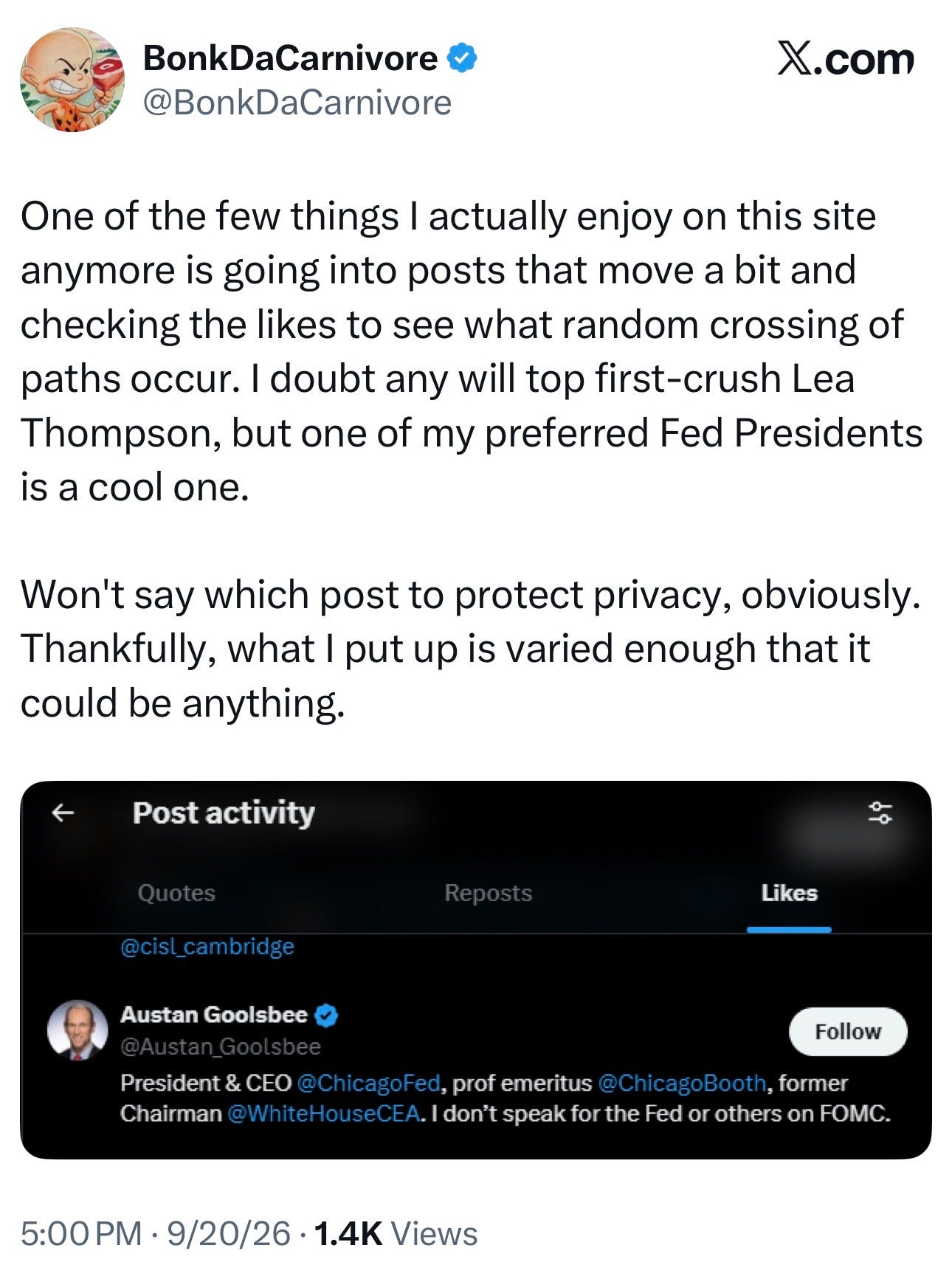
It’s another strange pairing. Bunk has assembled an intellectual family tree with Keynesians among his mentors and favorites, while pledging allegiance to a school that emerged in opposition to much of their tradition. It’s an eclectic mix he might have a hard time explaining beyond dropping some names alongside a few important-sounding words.
There’s one more curious detail. Goolsbee actually earned a PhD in economics from MIT. His dissertation is publicly cataloged. When Bunk noticed that Goolsbee had apparently liked one of his posts, he celebrated it as a “random crossing of paths,” making no mention of their supposedly shared academic lineage.
We can verify Goolsbee’s connection to MIT. Bunk’s remains another extraordinary claim we’re expected to accept on his say-so.
This also bears repeating: we could identify no economics PhD among the founding partners of America’s biggest, most influential venture capital firms.
All of this provides yet more evidence of Bunk unintentionally debunking himself by not knowing what he doesn’t know.
He doesn’t commit epistemic trespass solely on the topic of investing and economics, by the way. He also does it with lots of things, like claiming to have never been a practicing attorney despite also having won seven cases as…the attorney of record?

But this is all academic (pun!). While much of my overall critique has been objective in nature, there’s enough subjectivity woven into it to provide Bunk with his usual awkwardly-shaped escape hatches. He’ll just wave this all away with another form of retrospective scaffolding, which will be good enough for most Bunktards I’m sure.
We’re not done, though.
There is, fortunately, one category of claim that lends itself rather well to verification: Trades.
You see, markets are wonderfully indifferent in how they don’t care who you say you are, where you say you work, how much money you say you have, or how many randos applaud your proclaimed skills on the internet.
A trade was either called or it wasn’t. It either worked or it didn’t. And if enough of those calls can be audited, eventually they begin to tell a story of their own.
Lucky for us, Bunk has spent many months broadcasting trade callouts through his personal X account. We scoured his timeline and found 177 of them over the past couple years.
Some calls are explicit, often referred to as Trades of the Day (TotD). Others are vague. Some contain entries, exits, adds, and trims. Others acquire their precision only in retrospect. Winners are celebrated, while losers have a curious tendency to fade into the background.
And scattered throughout are the familiar artifacts of social media trading: screenshots, victory laps, retrospective references, evolving position descriptions, and claims about a broader record that the surviving public evidence does not always make easy to reconstruct.
This has led Bunk to routinely flex his trading prowess to his Bunktard masses.
He’s so good, we’re told, that he’s actually the greatest trader in the world. Or at least was during the first half of 2025.
#1 in the entire world. Literally.
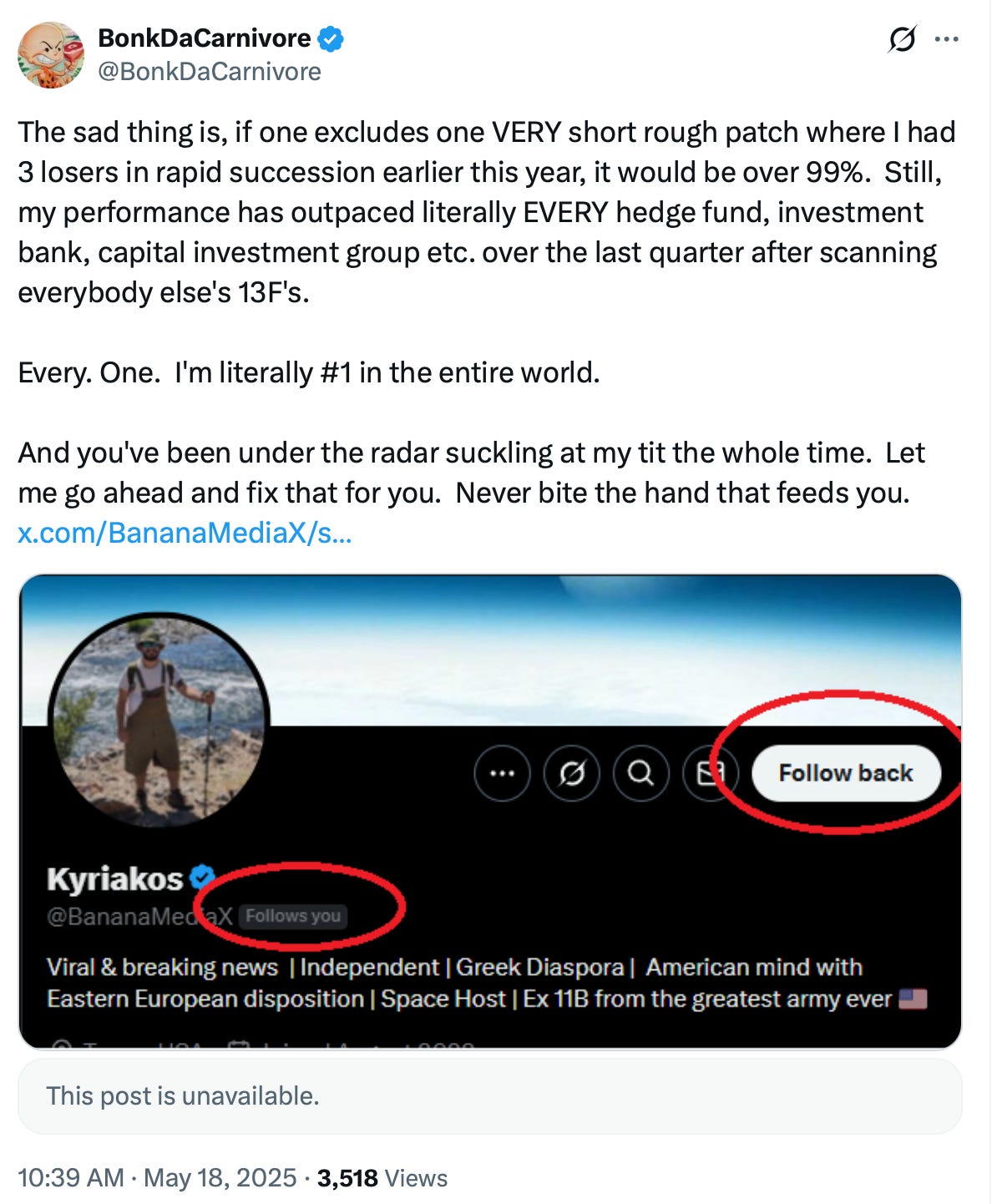
We’ve got another couple of tells here, by the way.
First, any heavy hitter worth his weight (pun intended) knows 13Fs are not a reliable guide for determining a fund’s performance.
That’s because these are only snapshots in time - published quarterly on a lag - which do not capture anything that could’ve happened to reported positions in the interim.
Moreover, they disclose certain long securities positions, including reportable puts and calls, but omit short equity positions and written options. They also leave out the transaction history and much of the information needed to reconstruct actual portfolio returns.
13Fs are mostly useful for social media to hyperventilate about every quarter. They most certainly aren’t all that useful in determining a fund’s actualized performance (unless it’s a long-only, buy-and-hold type of strategy). But that won’t stop Bunk from using it to make his point.
Second, EVERY hedge fund and investment bank is doing A LOT of work here. He treats very different businesses and mandates as contestants in some universal trading competition. I can assure you Bunk lacks insight into the performance of every hedge fund in existence - not to mention most of them pursue strategies entirely distinct from his own - and including investment banks as comps speaks to Bunk’s obvious naiveté about how any of this works.
That’s because proprietary trading at investment banks is a shadow of its former self ever since Dodd-Frank, which harshly constrained speculation amongst these groups following the Global Financial Crisis. Many banks just walked away from such activities altogether, while a few continue to dabble in smaller, modified form.
The fact is trading activity amongst investment banks today is largely confined to market-making/client execution and financing (eg, prime brokerage, margin lending, etc.). Client-facing trading still involves inventory risk and discretionary decisions, but that is a different business from the speculative trading Bunk is advertising.
So Bunk comparing his trade callout track record with an investment bank’s trading business fundamentally misunderstands what that business does. Not to mention there is zero chance Bunk could have access to the spec trading P&L of every investment bank in the world.
Lastly, I couldn’t help but chuckle at Bunk basically saying “excluding my losses” when winding up to flex his trading prowess against the greats. Apparently, his imaginary world trading championship allows mulligans for its very own scorekeeper.

We ultimately decided to stop listening to Bunk tell us how good he is and instead used his callout history to test his assertions ourselves.
Not the screenshots of P&Ls. Not the nonstop boasting. Not the “testimonials” from Bunktard nation. Not Bunk’s characterization of what happened.
The calls themselves.
What was said. When it was said. What could reasonably have been executed at the time. What happened afterward. And, just as importantly, what happened to the trades that seemed to fade from focus.
We then ran these trades through a little rubric we’ve built to analyze these callouts We won’t go into all the details here, but the rubric is designed around a simple premise: a trader’s record cannot be reduced to just a headline hit rate. (Those interested in learning more about our methodology can do so here).
Winning often matters, of course. But so does how much was risked to produce those wins, how efficiently capital was deployed, whether the results depended on a handful of outsized trades, how the strategy behaved across different market conditions, and whether the calls could actually have been executed as presented.
So we look beyond wins and losses to things like payoff quality, capital efficiency, execution realism, deployment integrity, and robustness versus fragility. You know, the types of things professional investors care about and analyze.
We also distinguish between what was knowable in real time and what only became clear in retrospect. The objective isn’t to find the most flattering way to score a trading record. It’s to ask a more useful question, which is how much confidence should we actually place in the performance being presented.
What follows is our attempt to reconstruct that record from the evidence available to us. So let’s forget the mythology for a moment and look at the tape.
Consider this a small preview of something we’ve been building quietly in the background these past several months.
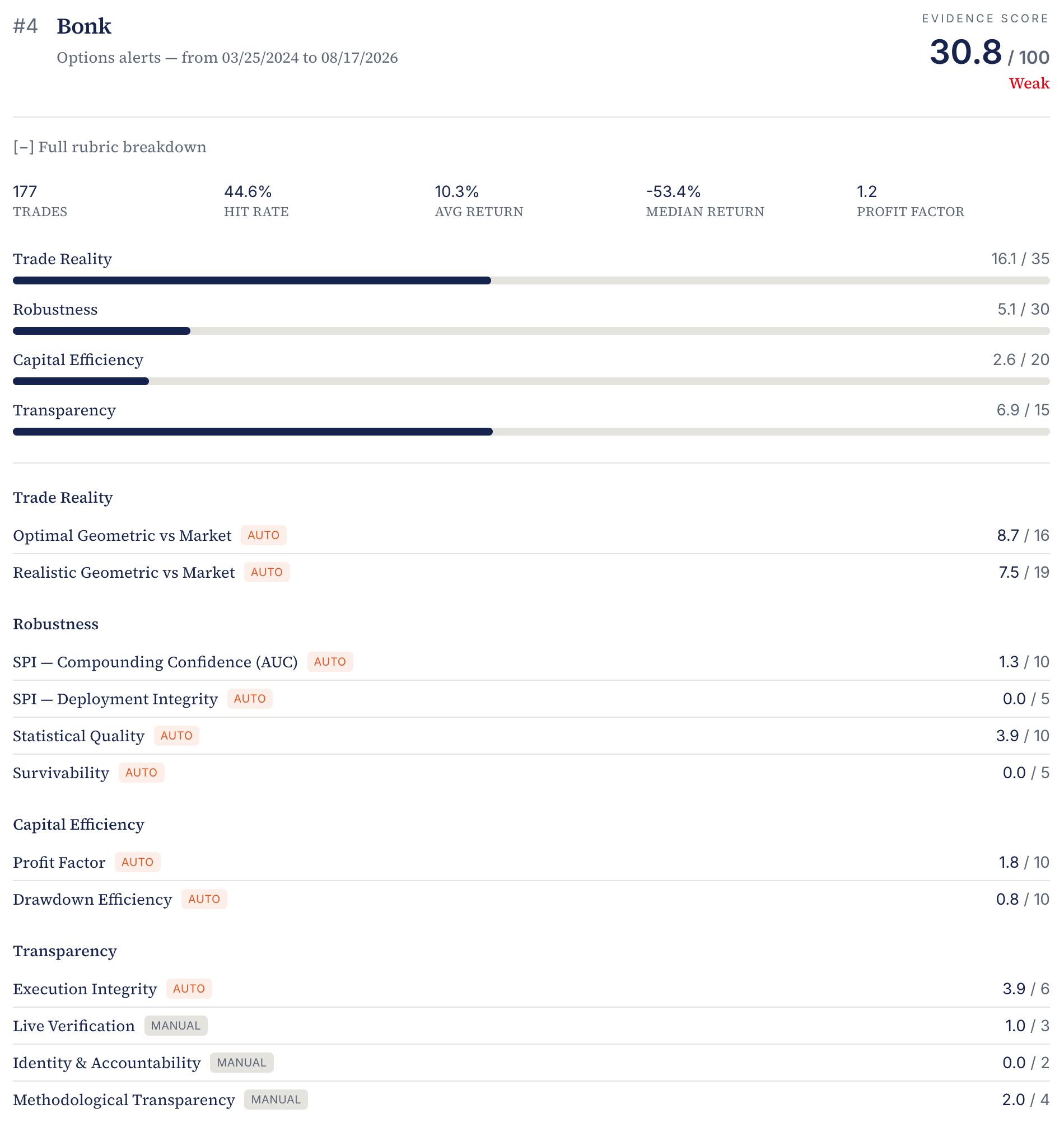
We examined 177 options trades publicly posted by Bunk on his X timeline between March 25, 2024 and August 17, 2026.
One headline number should immediately jump out given Bunk’s fantastical performance claims, which is the 44.6% hit rate (measured simply as whether a trade was profitable from announcement/open to closure/expiration).
Yes, fewer than half of Bunk’s callouts were winners. Not terrible in the grand scheme. But certainly a far cry from the near-perfect hit rate he claims.
You might next wonder how that hit rate squares with the 10.3% average return shown above. The −53.4% median return helps explain the disconnect.
A trader can lose more often than they win and still post a positive average return if the winners are large enough. Long options trades have an asymmetric payoff profile since the most you can lose is the premium paid, while a winner can return several times that amount. Outsized gains can therefore pull the average well above what a typical trade delivered. You can see that dynamic illustrated in the below distribution.
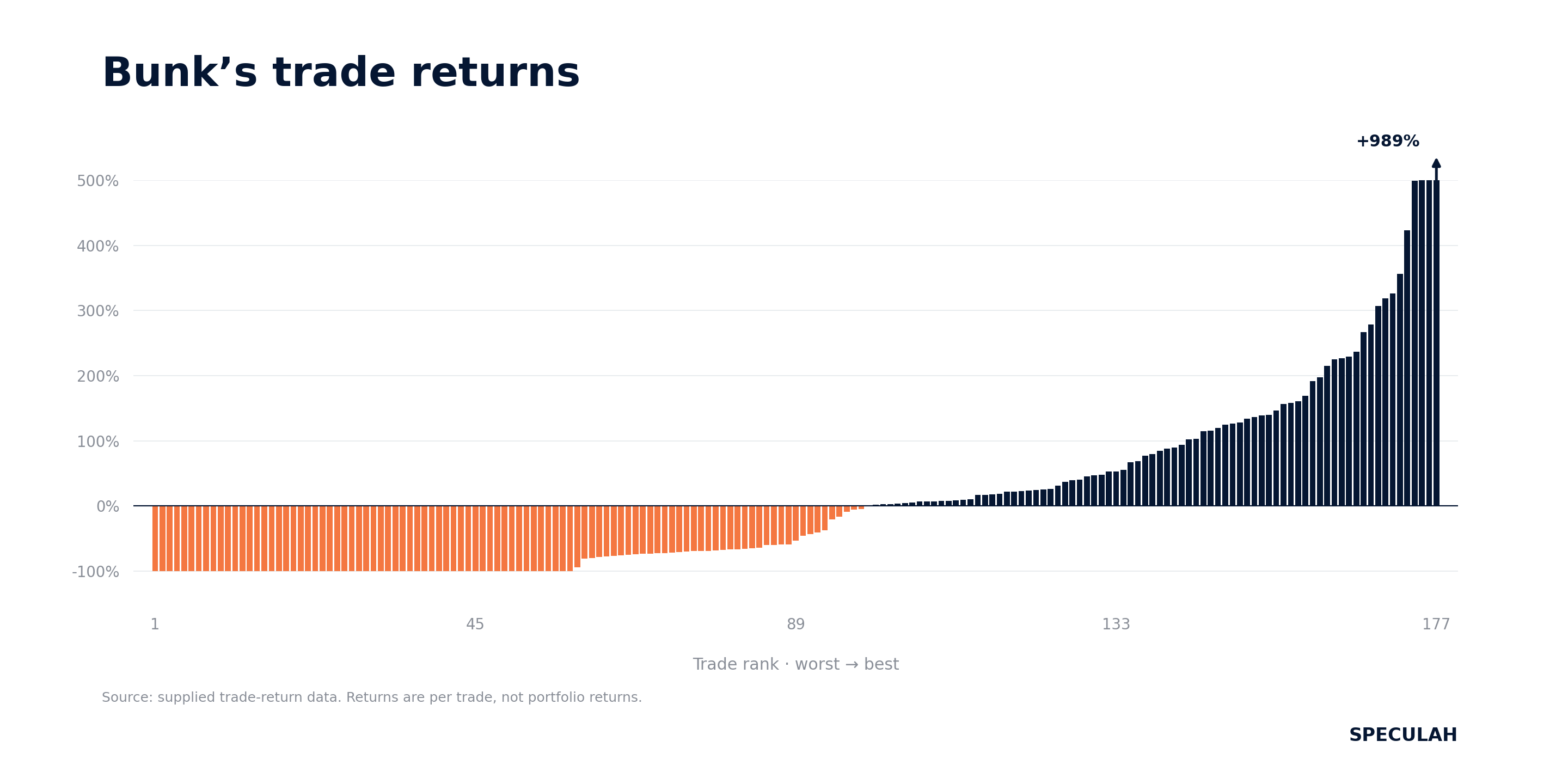
Across the 177 trades we evaluated, the average was positive, but the middle trade lost over half its value. Both figures matter in the full analysis. The average captures the contribution of large winners while the median reveals how punishing the typical outcome was. Neither figure, by itself, establishes what an investor’s portfolio would’ve earned.
The 1.2 profit factor adds context. Under our methodology’s sizing assumptions, winning trades generated approximately $1.20 in gains for every $1 in losses across losing trades. That’s a positive spread, but hardly the overwhelming dominance suggested by Bunk’s promotional claims.
The broader scorecard asks a more demanding question, which is how convincing these results are as evidence of a repeatable trading edge. Bunk earned 30.8 out of 100 available points, which our rubric rates as Weak.
The weakest areas were robustness (5.1/30) and capital efficiency (2.6/20). The hypothetical optimal-sizing scenario also earned more credit relative to its available points than the realistic-sizing scenario.
In plain English, the results offer little evidence that his approach could hold up consistently or use capital efficiently, and they look better when position sizes are optimized with the benefit of hindsight rather than under realistic sizing assumptions.
Taken together, the results offer a considerably less flattering picture than the positive average alone. More losers than winners, a median loss over 50%, and limited evidence that the strategy could compound capital under realistic conditions.
Large winners count, of course, but so does the experience of repeatedly losing money while waiting for them. It should be noted that these figures describe the callouts we captured and evaluated, so they do not represent a verified brokerage record or the return an actual follower would necessarily have earned.
But whatever else the numbers might tell us, they don’t support the image of a trader who almost never misses.
Just for shits and giggles, we also tested the below claim to a 98% hit rate during 2024.

Among the 48 public callouts we identified that both opened and closed or expired within calendar 2024, exactly half (50%) produced a positive reconstructed return under our methodology.
We selected five illustrative losers below to demonstrate how quickly that 98% claim can be ‘debonked’.

These five clean call alerts had no announced adds, trims, or exits. All five expired out of the money, producing a 100% premium loss when held to expiration under our methodology. Some may have offered profitable exits along the way, but no such exits were advised or announced.
To be clear, our analysis captures only trades Bunk publicly called out on his X timeline, so it’s possible he dramatically outperformed in his personal account or Discord callouts. But the public record we examined on X provides no support for the near-perfect performance he advertises.
There’s also a bit of irony with him calling someone out for admitting they pay for Discord access given Bunk’s own curious relationship with a couple of such services.
Though he doth protest very much about having no paid service or desire to be monetized, he has a curious habit of advocating on behalf of a couple other trading Discords. His favorite one appears to be run by someone whom he claims to be a protege that used to go by the handle @quinttrades on X. His Discord was formerly called B3T Trading but has since rebranded to Ironshell Capital.
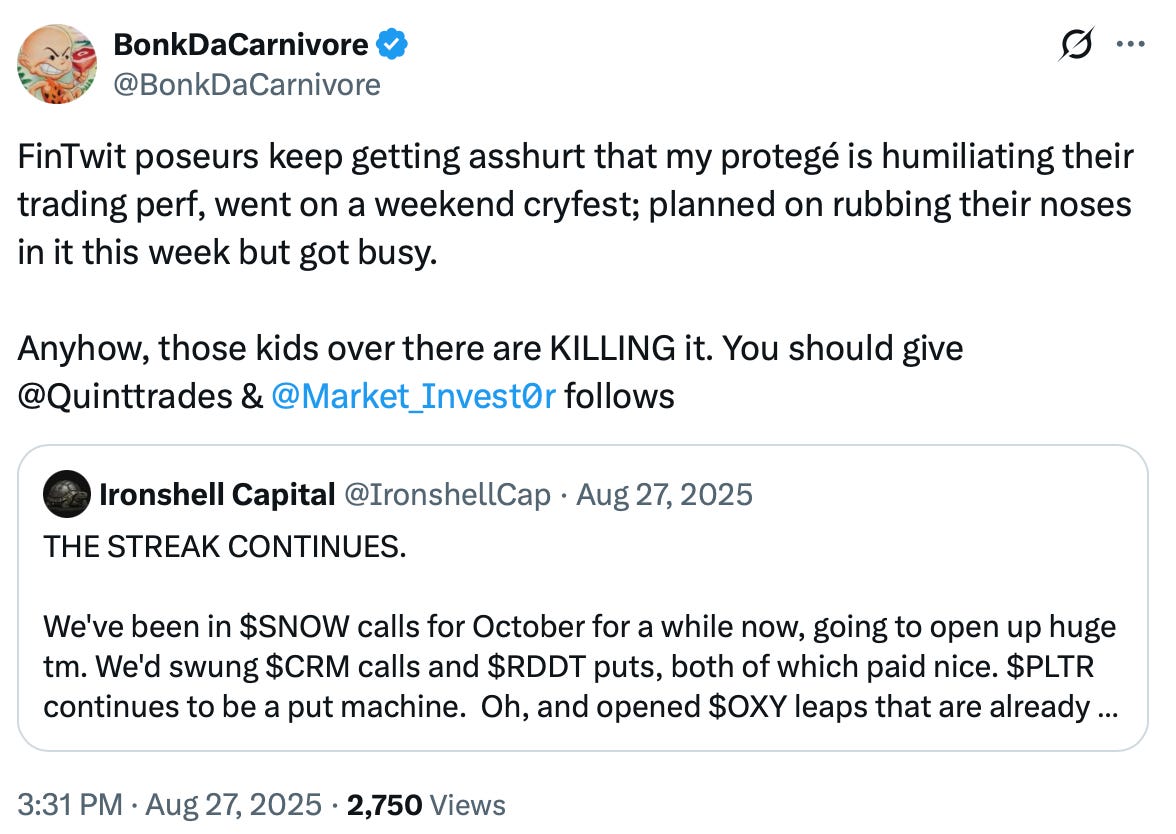
There’s been speculation amongst some that Bunk is secretly running that Discord and perhaps at least one other, as we’ve encountered some notable usage of the name “quintious” in some of our background work on Chance. But we couldn’t confirm any real details here so it’s hard to develop much conviction in that thesis.
Though I must admit something does appear a bit off. For example, when the quinttrades account suddenly disappeared from X one day, Bunk went out of his way to express great surprise at his missing pupil.
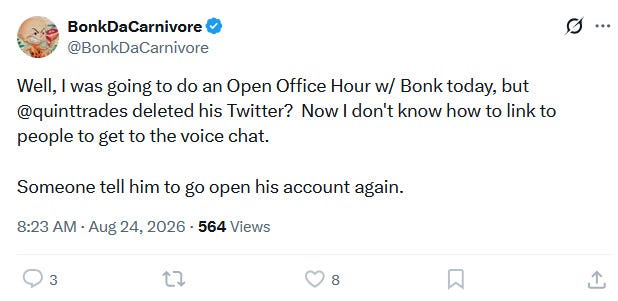
The objective seems obvious in its performative distancing, with Bunk potentially attempting to publicly observe that Quint is a separate person capable of making independent decisions that surprise him.
Even ignoring the earlier coincidences we uncovered, the logic train Bunk wants us to board easily derails when viewed in isolation:
Bunk called @quinttrades a former star pupil.
He described a trading partnership and actively promoted his star pupil’s trading Discord (B3T Trading).
He was supposedly planning a joint voice event that very day.
The Discord - and presumably its moderators - provided an obvious private communications channel.
Yet Bonk publicly asks strangers to tell Quint to reactivate X because he apparently has no other way to reach this close collaborator.

The strategy that may be involved here is known as a clean-room rebrand which, when coupled with a handle burn, helps keep the free furu persona (Bunk) formally separate from the paid room while secretly still operating it in the background.
If that were the arrangement, the net effect is the paid product continues, the acquisition channel (Bunk’s free TotDs and reputation) continues, and the paper trail that would make the two look like the same operation is harder to follow. It’s a common move used when an anonymous trading account wants a monetized Discord without the main persona looking like it’s selling the room.
This is a standard pattern with finfluencers, with one loud anon analyst sat alongside one or two “students” who run the server and swear the furu is real. Sometimes those students are other humans. Sometimes they’re sockpuppets. We’re not supposed to be able to tell those apart.
Again, just saying.
The Golden Age of Credibility Laundering
There is only so much mileage in establishing that Bunk is full of bunk. At some point, the more interesting question becomes how so much of it survives contact with the world.
How does someone accumulate this many contradictions and still command an audience? Why does checking his claims become evidence of an unhealthy obsession, while making them requires no explanation at all?
The sheer volume of nonsense is remarkable. So is how much volunteer work it takes to establish what a few ordinary questions should’ve exposed.
The answer, I suspect, requires very little coordination and a great deal of looking away. Platforms benefit from activity of any type - good, bad, or indifferent. Our golden age of credibility laundering begins when the institutions we rely on to expose bullshit discover they have more to gain by simply allowing or even endorsing it.
Eventually, exposing the fraud means exposing everyone who vouched for and enabled him, and that is a much less popular undertaking. People who lend him credibility have little incentive to challenge their own judgment and expose themselves to the embarrassment of revelation.
Followers get entertainment, affirmation, and a sense of belonging, so asking awkward questions puts those benefits at risk. Meanwhile, responsibility passes from one set of hands to another until it belongs to nobody in particular.
Whatever safeguards we imagine should intervene remain comfortably indifferent, while the burden of documenting, reporting, and rebutting falls on whoever happens to care enough. Bunk supplies the material while the surrounding indifference gives it room to breathe, compound, and expand.
If we consider the various characters and failure modes involved here, they’re aplenty.
X failed. Substack failed. GoFundMe failed. FINRA failed. The Colorado Bar failed. MIT failed. The Coast Guard failed. The Aurora Police Department failed. The Arapahoe County Sheriff’s Office failed. The Arapahoe County Court failed. The media failed.
Across these platforms and institutions, the reports and inquiries described above produced little visible accountability.
This is what institutional betrayal looks like, and it’s why we need projects like Speculah willing to do the work that others have found reasons to avoid. Its value lies in making scrutiny harder to escape, especially for people accustomed to having their manufactured status do the answering for them.
When institutions fail to impose consequences, making the record harder to bury is a useful place to start.
Which brings us back to Bunk, whose entire performance depends on keeping the distance between the character and the man conveniently out of view.
But we know the truth, and it’s one that paints a devastating picture.
Every time Chance opens X and logs on as Bunk, he is performing a humiliation ritual. Before he types a single word, he’s already confessed that the man he actually is can’t command the attention or respect he so desperately craves. So he puts on his little billionaire costume and gets to work.
And what a fucking costume it is.
Eight degrees, a venture capital empire, a $26 billion trading account, $30 billion+ in crypto holdings, Coast Guard SAR pilot, Jeopardy champion, and a Viking physique to boot. A résumé assembled by a lonely man who apparently believes every admirable quality can be acquired simply by boldly announcing it to strangers online.
Meanwhile, the public record we’ve examined paints a rather less heroic picture. Chance is, by my estimation, a bona fide loser whose only brush with notoriety comes courtesy of a character he invented.
He has spent years trying to convince the internet he’s one of the most extraordinary men alive, when his most impressive accomplishment appears to be maintaining a straight face through the mountain of bullshit he spews into the ether every day.
The scale of the performance is what gives the game away. A man secure in his life doesn’t need to be the richest, smartest, toughest, and most successful person in every room.
But Bunk does.
Because beneath all the bluster is a man so dissatisfied with his own reflection that he created an entirely new one. And he now spends his days desperately insisting the rest of us admire it, all while knowing virtually none of it is true.
But those of us with some combination of intellectual integrity, judgment, and basic common decency are not impressed. And we never will be. Because we know who Bunk truly is deep down, which is a fake, a phony, and a fraud.
This marks the end of my treatment of the infamously dumb and dishonest character named Bunk. I’m sure I’ll point and laugh on X from time to time, because he is awfully fun to ridicule. But we have bigger fish to fry at Speculah.
I’m also sure he’ll take no lessons from this, nor will most of his followers. How anyone can care about anything this man has to say after all this is beyond me, but I’m sure plenty of brainless believers will remain (something social media has taught me over the years is that the total addressable market for bullshit is much higher than we could’ve known).
Whether impossibly stupid or morally compromised beyond repair, Bunktards will rally around their gumby hero while he twists himself into yet another pretzel conducting narrative control. And I wouldn’t bet against more hilariously feckless threats of lawfare.
No real justice will ever come his way, thanks to the nature of this crooked world we currently occupy. For the rotten among us, now’s as good a time as any to lie, cheat, and steal, making Bunk very much a product of our misguided moment.
He is a petty bully dressed in billionaire caricature, demanding deference on the strength of accomplishments he cannot substantiate. Challenge the résumé and he reaches for threats, smears, and other people’s private pain. The credentials keep changing, but the viciousness stays consistent.
At the end of the day, we all know who he is, which is an overweight slob of a man with limited accomplishments and even fewer prospects.
I’ll rest peacefully knowing he deserves the pathetic little life he can’t escape on those rare occasions he puts his phone down.
And with that, we’ll have the great Chich Bull - the voice-modulated, resident bard of FinTwit - play us out with a song dedicated to the most obvious LARP ever.
Happy Halloween!
Whole life a costume, now wear it…